The Choice That Defined the Translation
The Douay-Rheims Latin Vulgate translation is the result of a deliberate and theologically grounded choice. Gregory Martin and his colleagues at Rheims faced a foundational question before they wrote a single word: which text should they translate from? The Protestant Bibles that had flooded England for the previous half-century, including Tyndale's, Coverdale's, and the Geneva Bible, were all made directly from the Hebrew Old Testament and the Greek New Testament. Their translators treated the original languages as the ultimate authority, and their work carried the freshness that comes from that decision.
Martin took a different path. He translated from Saint Jerome's Latin Vulgate, the version that had been the Bible of the Western Church for eleven centuries. When scholars pointed to the Greek manuscripts and suggested their rendering was more accurate, the response of the Rheims translators was direct: "The Latin Vulgate was the more preferable version, as it was the version of the Church, while the Greek text had for centuries been in the hands of heretics, and subject to their corruptions."
The choice was a theological argument, grounded in the Council of Trent's declaration that the Vulgate was "authentic," the only text to be used in public readings, disputations, and Church proceedings. For Martin and Allen, this was dispositive. The Church was the custodian of Scripture; her Bible was the Bible.
The Title Page States It Plainly
The Rheims New Testament announced this choice on its cover: The New Testament of Jesus Christ translated faithfully into English out of the authentical
Latin according to the best corrected copies of the same diligently conferred with the Greek
and other editions in divers languages.
The Douay Old Testament said the same: The Holie Bible faithfully translated into English out of the authentical Latin.
The word "authentical" was doing a great deal of work. The translators did compare their text against the Greek and other editions, but always with the Vulgate as the governing authority. Where the Greek and the Latin diverged, the Latin prevailed.
When the Latin Was Unclear
The price of this decision became visible at certain passages where the Latin text itself was obscure. Psalm 57:10 in the Rheims reads: "Before your thorns did understand the old Briar; as living so in wrath he swalloweth them." Barker judged that this literal rendering of a corrupted Latin text "seems impossible to put into clear and plain language." The Revised Version of 1885 would eventually make the passage intelligible: the image is of a cooking fire scattered by desert wind before it heats the pot. Martin's rendering follows the Latin faithfully; the Latin, in this instance, had ceased to make sense.
This was the unavoidable consequence of his method. Mombert's summary was blunt: the Douay Bible was "a faithful translation of the revision of a bad Latin version made from the Greek translation of the Hebrew original": a translation three removes from its source.
A Deliberate Philosophy
Hoare, examining the strange coinages that fill the translation, drew a conclusion that has survived scholarly scrutiny. "No man could be better aware than a scholarly Englishman like Gregory Martin that such renderings as these were simply barbarous." The Latinisms were a policy, not an accident.
The passage from Ephesians illustrates this most vividly. Chapter three, verses eight through
eleven, in the Rheims: To me the least of all the sainctes is given this grace, among the Gentils to euangelise the
unsearchable riches of Christ and to illuminate al men what is the dispensation of the
sacrament hidden from worlds in God, who created al things; that the manifold wisdom of God
may be notified to the Princes and Potestats in the Celestials by the Church, according to the
prefinition of worlds which he made in Christ Jesus our Lord.
Every choice preserves the Latin term; Potestats,
prefinition,
and sacrament
each anchor the English reader to the Vulgate
and prevent any drift toward Protestant equivalents.
Among the other characteristic coinages: "commessations," "contristate," "odible," "exinanited himself" (for the self-emptying of Philippians 2:7), "Purge the old leaven that you may be a new paste, as you are azymes" (for 1 Corinthians 5:7). Martin knew these words were barbarous. He used them because they preserved the theological precision of the Latin. Where a smooth English rendering might have introduced ambiguity, he preferred the difficulty of Latin transparency.
The Vocabulary That Resulted
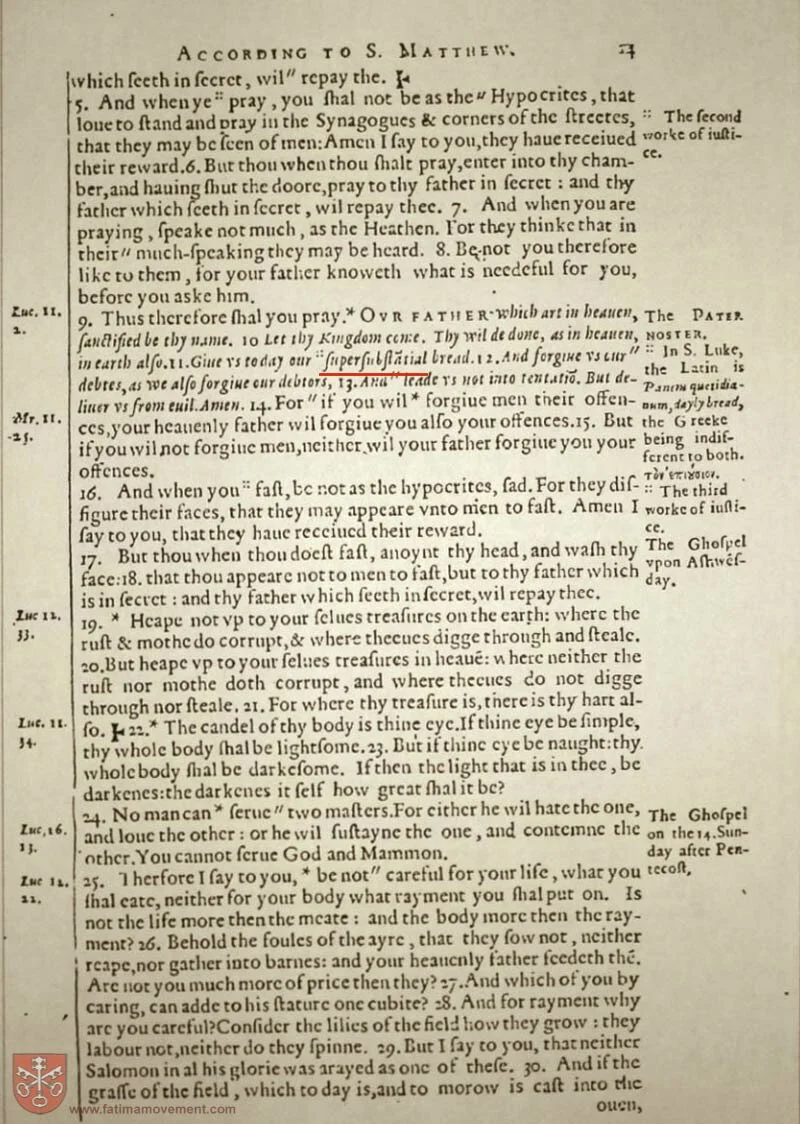
The practical consequence of translating from the Vulgate was a distinctive English vocabulary, unlike any other Bible translation before or since. Gregory Martin coined or preserved words directly from Saint Jerome's Latin: "exinanited" for Jerome's "exinanivit" at Philippians 2:7, where later translations give "emptied himself"; "concorporate" from "concorporales" at Ephesians 3:6; "comparticipant" from "comparticipes" in the same verse. These are not failures of translation but deliberate choices, carrying the meaning of Jerome's compounds into English as exactly as the language would allow.
The more familiar Latinate terms have endured. "Charity" for "caritas" in 1 Corinthians 13, where later translations give "love," preserves the specifically theological content of Jerome's word. "Penance" for "paenitentiam," where Protestant translations give "repentance," preserves the sacramental sense the original intended. "Supersubstantial" for the hapax legomenon "supersubstantialem" at Matthew 6:11 preserves a term with no established English equivalent and no easy modern translation. These choices reflect a theology of translation; the text is not to be made easy but to be made accurate, even at the cost of requiring the reader to learn new words. The Catholic Encyclopedia (1913) noted that the result was "so full of latinisms as to be in places hardly readable, but withal scholarly and accurate," and the translators included a glossary, acknowledging the difficulty openly.
What the Fidelity Gave
The same method that produced the Latinisms also produced some of the finest translations in the collection:
By their fruits you shall know them
(Matthew 7:16)Liberty of the glory of the children of God
(Romans 8:21)Holiness of the truth
(Ephesians 4:24)
In the first chapter of St James alone, the Rheims gave English its "upbraideth not," its "engrafted word," its "bridleth not," all adopted by the King James translators.
The care these Oxford classicists brought to the Latin text was real scholarship, even when its results were unreadable.
Hoare extended the argument to something larger: the Vulgate itself. Saint Jerome's Latin, he
argued, was the venerable source from which the Church has drawn the largest part of its ecclesiastical
vocabulary.
Terms now so familiar as to be taken for granted all derive from Saint Jerome's translation:
Scripture
Communion
Grace
Sanctification
Justification
Salvation
Penance
Sacrament
Eternity
Westcott, who had little sympathy for the Douay method overall, conceded the vocabulary argument: the language of the translation, whatever its stylistic failures, "is enriched by the bold reduction of innumerable Latin words to English service." The Rheims translators were the most rigorous carriers of Saint Jerome's vocabulary into English.
A Measured Assessment
Hoare's conclusion was measured and fair: the Rheims edition's uncompromising fidelity to the Vulgate, whatever its stylistic cost, carries the reader back to the Old Latin rendering of Greek manuscripts current in the middle of the second century, giving it a value for textual criticism that no later revision preserves. As The Challoner Revision shows in detail, subsequent revisions would begin to smooth away this character.
The Douay-Rheims Bible was frequently obscure, occasionally barbarous, and persistently difficult. It was also, in its way, a monument: to the Vulgate tradition, to the vocabulary Saint Jerome gave the Church, and to the willingness of its translators to sacrifice readability in the service of a fidelity they considered non-negotiable. This commitment to Jerome's Latin would later shift, as explored further in From the Authentic Latin to the Original Tongues, toward translations that drew directly from the Hebrew and Greek.
Sources
- Henry Barker, English Bible Versions: A Tercentenary Memorial of the King James Version; primary source for the quotations from Moulton, Hoare, Westcott, and Mombert on the Douay-Rheims translation method
- Cardinal John Henry Newman,
The History of the Text of the Rheims and Douay Version of Holy Scripture,
in Tracts Theological and Ecclesiastical - Rev. Henry Cotton, Rhemes and Doway: An Attempt to Shew What Has Been Done by Roman Catholics for the Diffusion of the Holy Scriptures in English (Oxford University Press, 1855)
← Born in Exile: The Origins of the Douay-Rheims Bible · Published in a Time of Crisis →