England in 1582
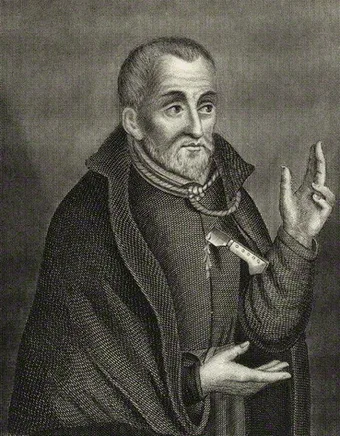
When the Rheims New Testament appeared in 1582, England was a country in a state of declared emergency. The previous year, Saint Edmund Campion, a Jesuit priest and former Fellow of St John's College, Oxford, had been arrested, subjected to torture in the Tower of London, and executed at Tyburn. The papal excommunication of Queen Elizabeth, issued by Pope Saint Pius V in 1570, had placed every English Catholic in an impossible position: loyalty to Rome was framed as treason, and treason carried the death sentence. War with Spain was already in the air. England's fate, many felt on both sides of the confessional divide, hung in the balance.
It was into this world that the Divines of the English College at Rheims released the first Catholic English New Testament. Henry Barker, writing three centuries later, observed that "the whole feeling of England was anti-Roman." The translators knew it. They published anyway.
The Approbation
The volume arrived with a formal Approbation signed by four doctors of theology at Rheims. In measured Latin, it declared that the translation contained nothing contrary to Catholic doctrine and nothing contrary to civil peace, and that it served the true faith, the common good, and the integrity of Christian life. The four signatories were:
- Pierre Remigius, Archdeacon of Rheims
- Hubert Morus, Dean of the Rheims Chapter
- Joannes Le Besgue, Canon and Theologian, Chancellor of the University of Rheims
- Guillaume Balbus, Professor of Theology at the Rheims College
Without this Approbation the translation had no standing in Catholic eyes. It also marked a claim: the Rheims version was the legitimate, authorized word of God in English, against every Protestant accusation to the contrary, as documented in the Catholic Encyclopedia (1913). The notes that accompanied the text left little to the imagination. They defended Catholic doctrine at every disputed point, attacked Protestant translations with considerable force, and spared neither Queen Elizabeth nor the Reformers of Germany, Switzerland, and France. Dr. Geddes, himself a Catholic priest, later described the annotations as "virulent," directed against the Protestant religion and calculated to support a system, as he put it, of "transalpine Popery." As described in A Bible of Arguments: The Annotations, these notes became the defining feature of the work.
Martin's Companion Work
Gregory Martin, the principal translator, had been preparing a companion polemic alongside the New Testament. His Discovery of the Manifold Corruptions of the Holy Scriptures by the Heretics of Our Days, published the same year as the New Testament though somewhat later in 1582, laid out his case against Protestant translations at length. The preface to the New Testament itself referred readers to this work: "more at large in a book lately made purposely of that matter, called a Discovery." For the full story of the translation's creation, see Born in Exile: The Origins of the Douay-Rheims Bible.
Martin wrote as a man in exile, translating in the knowledge that his work was a capital offense in his own country and that those who carried it there faced imprisonment or worse. Elizabeth's government treated the Rheims New Testament as a seditious document. Priests found carrying copies were imprisoned. The Crown's searchers seized copies wherever they were found. Those who circulated the New Testament faced, in some cases, torture.
The Question of Access
Even as they produced an English New Testament, the translators required Catholic readers to obtain a special license before reading it. As Paris Simms later observed, "no Catholic was permitted to read it until he had obtained a special license from the proper authorities." The Church's longstanding position on vernacular Scripture, and the theology behind that requirement, is taken up in a later article in this series.
Their stated motive for producing the translation at all was not a desire to place Scripture in every Catholic hand. It was the extensive circulation of Protestant English Bibles. As Paris Simms put it, "the growing demand for such among Catholics finally forced them to provide an English translation."
The Protestant Counter-Offensive
Protestant England responded with vigour. William Fulke, Master of Pembroke Hall at Cambridge, published his Defense of the Sincere and True Translations of the Holy Scriptures in 1583, a direct and rapid answer to Martin's Discovery of Corruptions. Thomas Cartwright, engaged at the instigation of Secretary Walsingham, was commissioned to prepare a more systematic refutation of the New Testament itself, though Archbishop Whitgift eventually prohibited him from continuing and transferred the task to Fulke. In 1585, Thomas Bilson, Warden of Winchester, published a further response addressing the political theology the Rheims translators had woven into their annotations.
The Refutation That Spread It
The most consequential response was Fulke's 1589 parallel edition, which printed the entire Rheims New Testament alongside the Bishops' Bible and argued against the Catholic annotations one by one. Passing through four printings, it placed the Rheims text in Protestant hands across England; by the time the King James translators gathered in 1604, it was among the most widely circulated New Testaments in the country. The consequences of that distribution are taken up in the next article.
What the Volume Contained
The physical volume that appeared in 1582 was a quarto, a page size roughly eight inches tall and six inches wide, running to approximately 745 pages. It opened with a formal Approbation signed by four doctors of theology at Rheims, a printed authority that declared the text free of doctrinal error and suitable for Catholic readers. It covered the four Gospels, Acts, the Epistles, and the Apocalypse.
The Approbation was followed by a substantial preface addressed "To the Right Welbeloved English Reader." This preface, several thousand words long, gave the translators' full account of why they had undertaken the work, why the Catholic Church now authorised the reading of Scripture in the vernacular, why the Vulgate was the correct source text, and what distinguished their translation from Protestant versions. It was, in itself, a polemical document of considerable skill, and it repays reading as an account of the intellectual world in which the translation was produced.
The translation occupied the central portion of the volume. Passages were set in roman type, with brief marginal notes identifying cross-references and offering short explanations. Below the text and in the margins ran the more substantial annotations; theological arguments, refutations of Protestant readings, explications of difficult passages, citations of the Fathers. These annotations often equalled or exceeded the biblical text in length, giving the volume the character of a combined translation and theological commentary. The Catholic Encyclopedia (1913) describes the annotations as the element that most distinguished the 1582 edition from any Protestant contemporary, and as the primary target of Protestant refutations in the decades that followed.
Sources
- Henry Barker, English Bible Versions: A Tercentenary Memorial of the King James Version
- Cardinal John Henry Newman,
The History of the Text of the Rheims and Douay Version of Holy Scripture,
in Tracts Theological and Ecclesiastical - Paris Marion Simms, The Bible in America: Versions that have Played Their Part
- Rev. Henry Cotton, Rhemes and Doway: An Attempt to Shew What Has Been Done by Roman Catholics for the Diffusion of the Holy Scriptures in English (Oxford University Press, 1855); source for the Approbation text, Martin's Discovery of Corruptions, and the Protestant responses
← A Translation from the Authentic Latin · A Bible of Arguments: The Annotations →