The Notes as Purpose
The Rheims New Testament arrived in 1582 in a quarto volume dense with annotations. They ran to hundreds of pages. They addressed Protestant translations point by point, passage by passage, doctrine by doctrine. Their purpose was stated on the title page itself: for "discoverie of the corruption of divers late Translations and for cleering the controversies in religion of these daies."
The notes were a sustained, learned, and at times ferocious engagement with the entire Protestant reading of Scripture, mounted from positions of considerable scholarship by men who knew they were writing for an illegal book in a hostile country.
Their Character
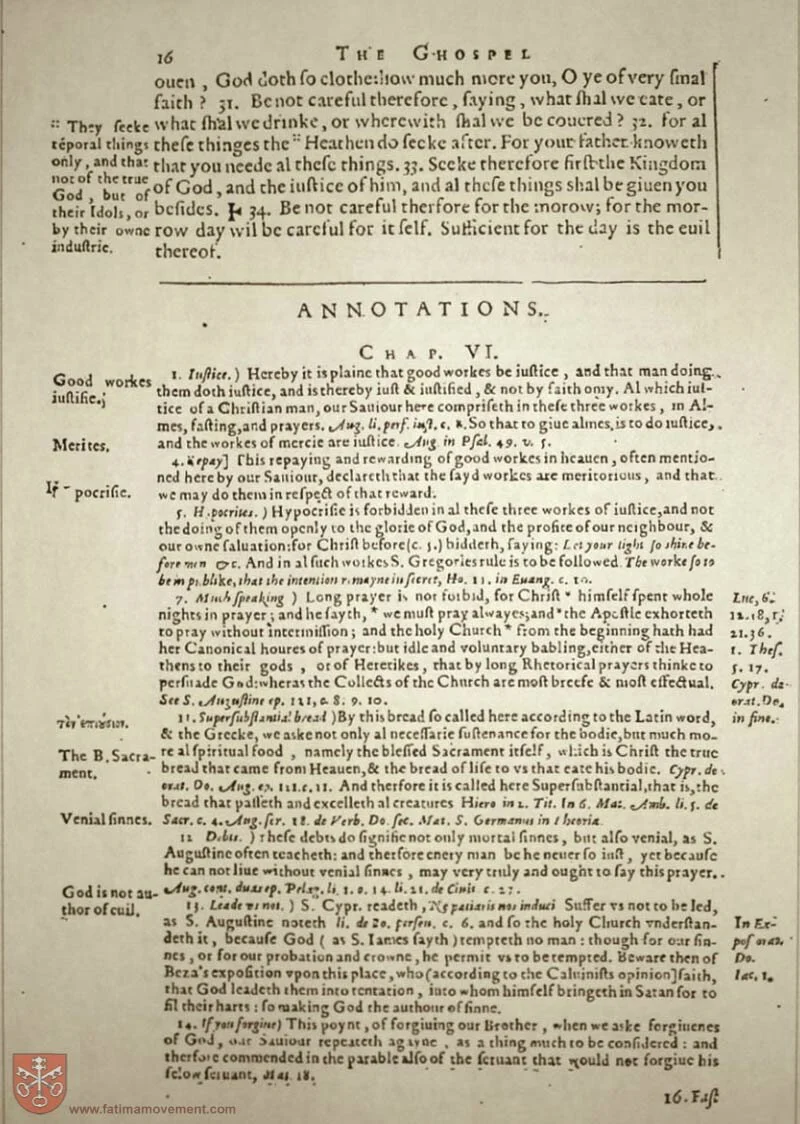
Henry Cotton catalogued the volume with characteristic precision. The annotations, he wrote, were "vindicating the translation, fiercely asserting all the peculiar doctrines of the Court of Rome, and employing the most bitter and contumelious terms in speaking of Protestants, and their doctrines, and their versions of Scripture." Dr. Geddes, himself a Catholic priest, described them as "virulent Annotations against the Protestant Religion, and manifestly calculated to support a system, not of genuine Catholicity, but of transalpine Popery." The Protestant scholar Mombert called them "ferocious," "savage," and "fanatical."
These are strong words, and the annotations earned them. To every disputed text, whether on the primacy of Rome, on the sacraments, on justification, or on the authority of tradition alongside Scripture, the notes arrived with formidable apparatus: Latin citations, patristic authority, logical argument, and a fierce refusal to concede any ground to Protestant interpretation. Cotton observed that "it would be difficult to find a more studied series of deliberate insults, than these Notes contain: and where could such sentiments and language be more out of place and more indecent, than in a professed commentary on the Gospel of Jesus Christ?"
Designed as a Doctrinal System
Richard Bristow and Cardinal Allen had prepared the annotations concurrently while Gregory Martin translated the text; the work of annotating was as much their production as the translation itself. The argument for each of the distinctive doctrines of Rome, including transubstantiation, purgatory, the real presence, and the authority of tradition alongside Scripture, was worked out at length beside every disputable passage.
The same argumentative tradition persisted in later annotated Catholic editions. Cotton noted that in Robert Witham's 1730 New Testament, the argument prefixed to the Gospel of John "treats professedly of Heresies; and contains much condemnation of Protestants, of private judgment, vernacular translations, the general perusal of Scripture." The notes to the Apocalypse were "preeminently controversial; designed to defend the Church of Rome from the interpretations given by Protestant Divines." One of those notes ran to six and a half pages of small print, arguing that the Pope could not be the Antichrist described in Revelation.
Barker observed the distribution of the doctrinal argument plainly: "There are renderings here and there which may be said to favour Roman Doctrine, but they are few and far between. It is in the notes that Roman Doctrine is perseveringly and strenuously taught."
Protestant England's Response
Protestant England, reading these notes, recognized them as a serious challenge. Thomas Cartwright, professor of divinity at Cambridge and leader of the Puritan party, was engaged by the Earl of Leicester and Sir Francis Walsingham as early as 1583 to write against the Rheims version specifically. Archbishop Whitgift, who had little sympathy for Cartwright's Puritanism but a great deal of concern about the Rheims annotations, eventually prohibited him from continuing; the work did not fully appear until 1618, nearly thirty-five years after Cartwright had begun it, and after his own death.
Fulke took up the task instead. His 1589 parallel edition printed the Rheims text alongside the Bishops' Bible and argued against the Catholic annotations one by one. In printing what he refuted, he spread the Rheims text and its arguments throughout Protestant England.
A Peculiar Immortality
The annotations were the most controversial part of the work: the part that drove Protestant England to mobilize its scholarly apparatus in response. They were also, through that response, what spread the Rheims text so widely. Fulke's refutation required him to print the notes he was arguing against. In trying to bury the Catholic argument, he preserved it in a form that would circulate through four printings.
When the translators of the King James Version gathered in 1604, Fulke's parallel edition was among their working texts. The annotations that Bristow and Allen had composed to defend Roman doctrine against Protestant corruption had, through the mechanism of refutation, contributed to the making of the greatest Protestant English Bible. That is a peculiar sort of immortality.
The text on this site presents Gregory Martin's translation without the annotations of 1582. It is possible to read the original Douay-Rheims as a bare text. Its authors never intended it to be read that way.
Their Legacy
The annotations produced an unintended consequence that their authors would have found ironic. In 1589, the Cambridge Master William Fulke published a systematic Protestant refutation of the Rheims New Testament by printing the entire Catholic text alongside the Bishops' Bible in parallel columns and answering each annotation point by point. Fulke aimed to discredit. His method placed the Rheims translation, and its arguments, into every serious Protestant biblical scholar's library in England.
When the King James translators gathered in 1604, Fulke's parallel edition was among the most widely circulated English New Testaments in the country. The annotations they had intended to refute became, through Fulke's inadvertent distribution, a working reference for the committee producing the Protestant masterpiece. Ward Allen's edition of the King James translators' revision notes, published in 1969, found that a significant proportion of their proposed textual improvements in the Epistles drew on readings first found in the Rheims translation. For a full account of this debt, see How the Douay-Rheims Shaped the King James Bible.
The annotations also shaped the tradition of Catholic biblical commentary in English. The learned engagement with Scripture that Gregory Martin and Richard Bristow had modelled in 1582 continued, in modified form, through the centuries that followed, as Witham's 1730 New Testament and later annotated editions attest.
The Annotations After Challoner
Bishop Challoner did not carry the original annotations into his revision. His editions of 1749 and 1752 replaced the dense polemical apparatus of Bristow, Reynolds, and Worthington with shorter, devotional notes suited to ordinary Catholic readers in eighteenth-century England. The doctrinal arguments that had occupied hundreds of pages in the 1582 original were largely dropped; Challoner drew on their substance in composing his briefer substitutes, but the original notes did not survive the revision intact.
As a result, the full annotations of 1582 are accessible today only through the original editions and scholarly facsimiles. The 1582 Rheims New Testament and the 1609-1610 Douay Old Testament, available through library facsimile editions and digitized copies on the Internet Archive, preserve the annotations as Bristow, Worthington, and Allen composed them. The text on this site presents Gregory Martin's translation without those notes, as the Challoner revision has transmitted it.
Sources
- Rev. Henry Cotton, Rhemes and Doway: An Attempt to Shew What Has Been Done by Roman Catholics for the Diffusion of the Holy Scriptures in English (Oxford University Press, 1855), primary source for Cotton's descriptions of the annotations and the Protestant responses
- Henry Barker, English Bible Versions: A Tercentenary Memorial of the King James Version, source for Geddes's and Mombert's characterizations of the annotations
- Cardinal John Henry Newman,
The History of the Text of the Rheims and Douay Version of Holy Scripture,
in Tracts Theological and Ecclesiastical - Paris Marion Simms, The Bible in America: Versions that have Played Their Part
← Published in a Time of Crisis · A Bible Forbidden to Its Own Readers →