The English Reformation
The origins of the Douay-Rheims Bible lie in the English Reformation's most disruptive consequence: the permanent exile of English Catholic scholars from their own country. When the Acts of Supremacy and Uniformity made the practice of Catholicism illegal in England, the men who would produce this translation had to leave. Their destination was the European continent, and their mission was to keep the Catholic faith alive among the English.
The consequences for Catholics who refused to conform were severe. Recusancy (the refusal to attend Church of England services) brought heavy fines and imprisonment. Functioning as a Catholic priest in England constituted legal high treason, punishable by execution. By the end of Elizabeth's reign in 1603, an estimated two hundred Catholics had been put to death for their faith.
The English College at Douai
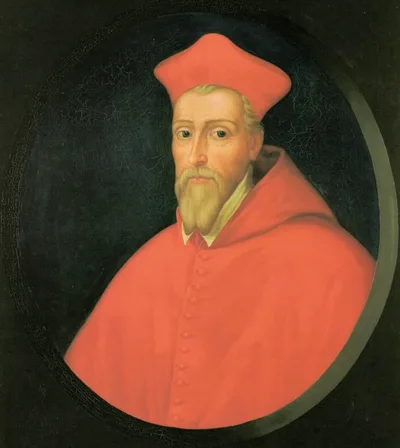
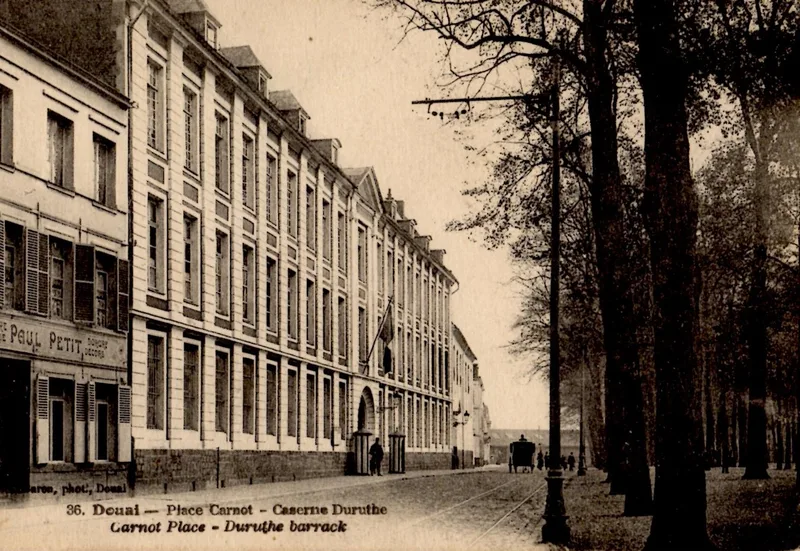
It was against this backdrop that William Allen, a former Fellow of Oriel College, Oxford, conceived a plan to preserve English Catholic scholarship and train priests for the dangerous mission of ministering to Catholics in England. On 29 September 1568, he founded the English College at the University of Douai in the Spanish Netherlands (now northern France).
The college became the intellectual heart of English Catholicism in exile. It attracted a remarkable concentration of Oxford-educated scholars who had left England rather than conform to the new religious settlement. Over the course of its existence, the college sent more than three hundred priests back to England, knowing that capture likely meant death. Approximately one hundred and sixty of these missionaries were executed, becoming known as the Douai Martyrs. The first to die was Cuthbert Mayne, put to death in 1577.
Gregory Martin and the Translation
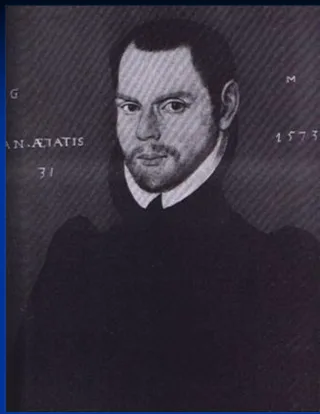
Among the scholars who gathered at Douai was Gregory Martin (c. 1542–1582), one of the original students at St John's College, Oxford, and a close friend of Saint Edmund Campion. Martin arrived at the college in 1570, was ordained in 1573, and spent two years helping to establish the English College in Rome before returning to the continent.
In 1578, political unrest in the Low Countries forced the college to relocate temporarily to Rheims. It was here, in October 1578, that Martin began his monumental work of translating the entire Bible from the Latin Vulgate into English. Working with extraordinary discipline, translating roughly two chapters each day, he is believed to have completed the entire text by July 1580, a span of less than two years.
For the theology behind that choice, see A Translation from the Authentic Latin.
His work was not solitary. Allen, together with Richard Bristow and William Reynolds, reviewed Martin's translation daily and prepared the extensive theological annotations that would accompany the text. These notes were not mere commentary; they were carefully argued responses to the doctrinal claims of the Protestant Reformers, addressing contested passages of Scripture point by point.
Publication
The Rheims New Testament, 1582
The New Testament was published first, in 1582, while the college was still at Rheims. It appeared in quarto format in a print run of only a few hundred copies, accompanied by dense annotations. The text was distinctive for its heavily Latinate vocabulary, a deliberate choice reflecting the translators' fidelity to the Vulgate and their conviction that certain theological concepts were best expressed in terms closely derived from the Latin.
Gregory Martin did not long survive his achievement. He had contracted tuberculosis, and died on 28 October 1582, the same year his New Testament was published. He was approximately forty years old. William Allen delivered his funeral sermon. His tomb in Rheims was lost during the French Revolution.
The Douai Old Testament, 1609–1610
Although Martin had completed the Old Testament translation by 1580, financial difficulties prevented its publication for nearly three decades. It finally appeared in two quarto volumes from Douai: Genesis through Job in 1609, and Psalms through 2 Maccabees (together with the apocryphal books) in 1610. By this time the college had returned to Douai from Rheims, which is why the complete work bears the names of both cities.
Reception and Legacy
The completed Douay-Rheims Bible entered a hostile environment. In England, possessing it was a criminal offense. Yet its influence extended beyond Catholic circles. The translators of the King James Version, published just one year after the Douai Old Testament in 1611, acknowledged the Rheims New Testament in their preface and drew upon it significantly. Scholarship has shown that roughly a quarter of the proposed revisions to the Gospels in the KJV adopted readings from the Rheims text.
The Douay-Rheims remained the sole authorized English Bible for Catholics for over three centuries. In the mid-eighteenth century, Bishop Richard Challoner would undertake a substantial revision that made the text more accessible to contemporary readers, though at the cost of much of Martin's distinctive Latinate character.
The text presented on this site is Martin's original, as it appeared in 1582 and 1609–1610, with only light modernisation of spelling and punctuation. It is a monument to the faith and scholarship of a community that risked everything to preserve the word of God in English.
The Delay
The interval between the New Testament's appearance in 1582 and the Old Testament's publication in 1609-1610 was not a gap in translation but a gap in funding. Gregory Martin completed his draft of the entire Bible, both Testaments, by around July 1580. The New Testament was ready for the press at Rheims shortly afterward. The Old Testament waited.
The English College had moved from Douai to Rheims in 1578, driven out by the anti-Spanish, Calvinist unrest convulsing the Low Countries and given refuge under the protection of the House of Guise; it returned to Douai in 1593, after the political climate shifted. These moves consumed resources and administrative energy that might otherwise have supported publication. The death of William Allen in 1594 removed the figure who had driven the original project. The Old Testament manuscripts were carried between cities and eventually prepared for the press by Thomas Worthington, who had become president of the English College. He saw them through publication in 1609 and 1610.
The twenty-seven-year gap therefore reflects the material conditions of a community in exile: the cost of printing, the disruptions of repeated relocation, and the deaths of the men who had initiated the work. Gregory Martin himself, the translator who had produced the entire text, died on 28 October 1582, the same year his New Testament appeared and more than a quarter-century before his Old Testament followed. For the full story of what happened to this translation after publication, read The Challoner Revision.
Sources
- Rev. Henry Cotton, Rhemes and Doway: An Attempt to Shew What Has Been Done by Roman Catholics for the Diffusion of the Holy Scriptures in English (Oxford University Press, 1855)
- Henry Barker, English Bible Versions: A Tercentenary Memorial of the King James Version
- Cardinal John Henry Newman,
The History of the Text of the Rheims and Douay Version of Holy Scripture,
in Tracts Theological and Ecclesiastical
← History of the Douay-Rheims Bible · A Translation from the Authentic Latin →