Maryland, 1634
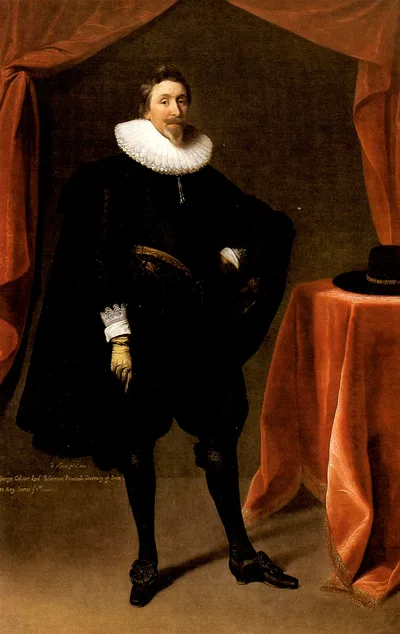
The Douay-Rheims Bible in America begins with the founding of Maryland in 1634. Roman Catholics settled Maryland that year under Cecilius Calvert, the second Lord Baltimore, who directed the colony from England while his brother Leonard led the party of colonists to the Chesapeake; the settlement included Catholic priests. John Gilmary Shea, the nineteenth-century historian of the Catholic Church in America, believed they brought the Rheims-Douai Bible with them. Whether or not that first crossing carried a copy, the Bible entered American life during those early Maryland years, in the hands of a community that had left England for the freedom to worship openly.
Maryland was not exclusively Catholic. Many Protestants settled there as well, and the King James Version came to the colony as naturally as the Rheims-Douai. As P. Marion Simms documented in The Bible in America, "there is as much probability, perhaps, that the King James Version came over in 1634 as there is that the Rheims-Douai came at that time." The two Bibles coexisted, as the two communities did, in a colony whose charter had promised religious tolerance.
Two Bibles Made in Exile
The parallel between the two great English translations is striking. Protestant exiles from England, gathered at Geneva during the reign of Mary Tudor, produced the Geneva Bible. When Elizabeth restored the Protestant settlement and Catholics fled to the continent, they gathered at Douai and Rheims and produced the Rheims-Douai. Both were translations made in exile, shaped by the experience of displacement and persecution. Both eventually crossed the Atlantic with communities carrying their faith to a new world.
A Difficult Reception in England
The Rheims New Testament had a difficult passage through Elizabethan England. Elizabeth's government treated it as a seditious document. Priests found carrying copies were imprisoned. The Crown's searchers seized copies wherever they were found. Those who circulated the New Testament faced, in some cases, torture. Many copies were confiscated and destroyed. The Bible travelled to America partly because America offered fewer of these obstacles. Maryland's earliest years gave it room the Old World had not.
The First American Catholic Bible
The first American printing of a Catholic Bible did not appear until 1790, in Philadelphia: as described in The Challoner Revision, Challoner's revised text was published for the American Catholic community that had grown through the colonial period and was finding its footing in a new nation. Mathew Carey, a Catholic immigrant from Ireland who had become one of the most successful publishers in the young republic, printed that first edition and followed it with a second, illustrated edition in 1805, also in Philadelphia.
Carey's 1790 edition was intended as a definitive Catholic Bible for the American market, though subscriptions fell short of what he had hoped and only a few hundred copies were printed. It carried the Challoner text and annotations, now several generations removed from the original Rheims-Douai of 1582, but still bearing the same name.
Bishop Kenrick's Translation
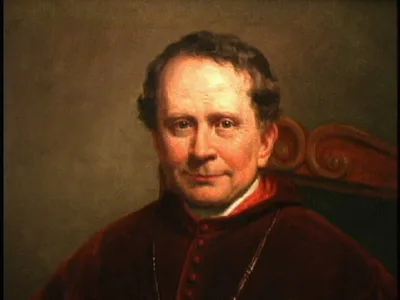
Bishop Francis Patrick Kenrick of Philadelphia, later Archbishop of Baltimore, undertook a thorough revision of the Rheims translation. His Four Gospels appeared in New York in 1849, the rest of the New Testament and the Apocalypse in 1851, with Old Testament volumes following in subsequent years. Kenrick translated from the Latin Vulgate, diligently compared with the original Greek text, and his work represented the most substantial American contribution to Catholic biblical scholarship in the nineteenth century. Readers can compare the original pre-Challoner text with Kenrick's source material by reading Genesis in the original Douay-Rheims.
His translation reflected the coming of age of an American Catholic intellectual life. The community that had arrived in Maryland with a handful of priests and a Bible brought from England had grown, through immigration from Ireland, Germany, and Southern Europe, into a major presence in American religious life. Kenrick's work served that community's need for a translation that was both scholarly and American.
The Name That Endured
The Rheims-Douai Bible, in its various editions, accompanied American Catholics through the nineteenth century. Challoner's name was on most title pages. Cardinal Wiseman had declared it an abuse of terms to call any of these editions by the older name, a pattern documented in After Challoner: A Bible in Dispute. But the communities that read them knew them as the Catholic Bible: the one that had come across the ocean, in one form or another, from the beginning.
The text presented on this site is the original, pre-Challoner Douay-Rheims, as first published in 1582 and 1609-10. It is the text that preceded all the revisions, the one that Gregory Martin and his colleagues produced in exile, and that was carried, in the hands of priests and laypeople, across the Atlantic to a new world.
Bishop Carroll and the First American Edition
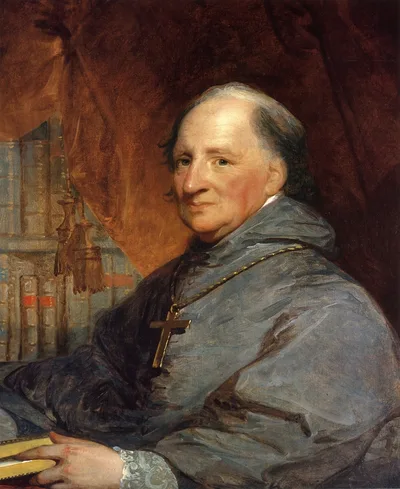
The first American printing of a complete Catholic Bible was organized in Philadelphia in 1790 by Mathew Carey, an Irish-born publisher who had emigrated to Pennsylvania in 1784. Carey worked with John Carroll, who had been appointed the first Catholic bishop of the United States that same year, and whose oversight of the young American Church gave him a direct interest in providing an accessible Bible for Catholic immigrants.
The 1790 Carey Bible used Challoner's revised text, the only edition then readily available for Catholic readers. Subscriptions ran well short of Carey's hopes, and only a few hundred copies were printed for an American Catholic population of roughly 25,000; Carey nonetheless went on to print further Catholic Bible editions in 1805, 1816, and beyond, and other publishers, including Bernard Dornin in New York, followed with additional printings through the first decades of the nineteenth century. As Simms recorded, by 1831 at least fourteen American editions of the Douay-Rheims had appeared, all derived from Challoner's revision.
The association between the Douay-Rheims Bible and American Catholic identity was established in these decades. As wave after wave of Irish, German, and Italian Catholic immigrants arrived, the Challoner text came with them, bound in the same editions that Carey's firm had first printed. The original pre-Challoner text of 1582 and 1609-1610, meanwhile, was essentially unknown in America and would remain so for over a century.
Sources
- Paris Marion Simms, The Bible in America: Versions that have Played Their Part, primary source for the Maryland settlement, the parallel with the Geneva Bible, and the difficult English reception
- Cardinal John Henry Newman,
The History of the Text of the Rheims and Douay Version of Holy Scripture,
in Tracts Theological and Ecclesiastical - Rev. Henry Cotton, Rhemes and Doway: An Attempt to Shew What Has Been Done by Roman Catholics for the Diffusion of the Holy Scriptures in English (Oxford University Press, 1855), chronological list of American editions including the 1805 Carey Bible and Kenrick's translation
← After Challoner: A Bible in Dispute · From the Authentic Latin to the Original Tongues →