What Trent Actually Said
The question of which languages Catholic translators should use has a history spanning four centuries and three major ecclesiastical interventions. The Catholic Bible's relationship to the original Hebrew and Greek of Scripture is not a simple story of progress; it is a story of considered theological reasoning at each stage, from the Council of Trent's endorsement of the Latin Vulgate to Pius XII's 1943 encyclical authorizing direct translation from the original languages.
The Council of Trent, in its fourth session in 1546, issued a decree that would govern Catholic biblical translation for nearly four hundred years. It declared that the Vulgate, long used throughout the Western Church, was to be held "as authentic" for "public readings, disputations, sermons, and expositions."
This was a practical judgment, not a claim of textual perfection. The Council fathers were not declaring Saint Jerome's Latin superior to the Hebrew and Greek from which it was translated. As the Catholic Encyclopedia later put it, the Council, "without depreciating the Hebrew or the Septuagint or any other version then in circulation," approved the Vulgate for the Church's own use. Its authority was what later theologians would call juridical rather than critical. The Vulgate was the established, approved standard for the Latin Church, the text on which centuries of liturgy, preaching, and theological argument had been built. That history gave it a settled, practical authority for the life of the Western Church. The Council confirmed that authority; it did not pronounce on questions of textual scholarship. The Council of Trent's text is discussed in the Catholic Encyclopedia (1913).
The Douay-Rheims translation, produced by Gregory Martin and his colleagues in the 1580s and finished in 1610, embodied this principle with unusual rigor. Their translation followed the Vulgate word for word wherever possible, as explored in A Translation from the Authentic Latin, preserving Saint Jerome's Latin in English with a literalism that prioritized theological precision over readability. That literalism is visible throughout the text, from Genesis 1 to the Epistles of Saint Paul, as documented in English Bible Versions. The Challoner Revision, and the long succession of editions that followed all worked from the same base. For nearly three centuries after Trent, no authorized Catholic translation in English worked directly from the Hebrew or Greek.
The Nineteenth-Century Opening
The first significant movement came in 1893, when Leo XIII issued the encyclical Providentissimus Deus. Addressed to the challenges that historical and philological criticism had raised for Catholic readers, it encouraged Catholic scholars to learn Hebrew, Greek, and related languages, to familiarize themselves with the tools of modern textual criticism, and to bring scholarly rigor to their work with Scripture.
The encyclical did not change the translation requirement. Catholic versions were still expected to be made from the Vulgate. But Leo's encouragement of original-language study set something in motion. A generation of Catholic scholars grew up learning to work with Hebrew and Greek manuscripts, and they eventually produced the case for a more fundamental change. Individual Catholic translators had already begun to test the limits: John Lingard's translation of the Four Gospels in 1836 worked directly from the Greek, as did Fr. Francis Spencer's complete New Testament in 1937, the first by a Catholic in English from the Greek original. These were scholarly ventures ahead of official sanction, but they demonstrated what was possible.
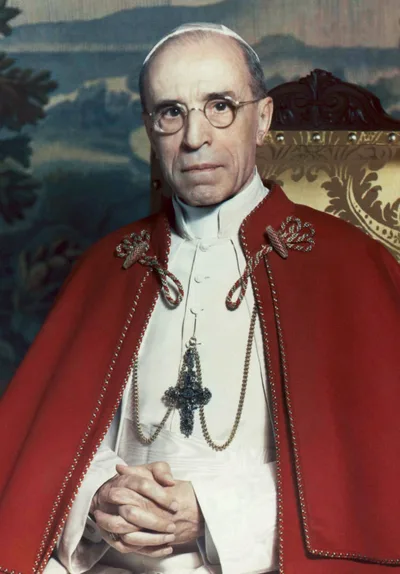
Divino Afflante Spiritu (1943)
On September 30, 1943, the feast of Saint Jerome, Pope Pius XII issued Divino Afflante Spiritu. It marked the fiftieth anniversary of Providentissimus Deus, and it completed what Leo XIII had begun.
The encyclical authorized and encouraged Catholic scholars to translate directly from the original languages. Its reasoning was explicit: "the original text which was written by the inspired author himself and has more authority and greater weight than any, even the very best, translation" was what interpreters ought to explain. The Vulgate had acquired "long use in the Church" and the force of ecclesiastical approval. But Trent's decree of authenticity, Pius XII clarified, was juridical in character. It established the Vulgate's authority for official Church use, for readings and disputations in the Latin Church. It settled no question in textual criticism.
This clarification mattered considerably. For four centuries, Trent's "authentic" had sometimes been read as a declaration of textual superiority, a claim that the Vulgate preserved the inspired text more faithfully than the surviving Hebrew and Greek manuscripts. Pius XII corrected that reading. The Council fathers had made a practical decision about which text the Latin Church would use in its public life. What they had not done was pronounce on the relative accuracy of the Latin, Greek, and Hebrew traditions as witnesses to the inspired originals.
Catholic translators, Divino Afflante Spiritu made clear, should now work where their
scholarship could reach most deeply: from the texts as the inspired writers composed them. The
biblical scholar Raymond Brown later described the encyclical as a Magna Carta for biblical progress.
The Translations That Followed
The years after 1943 saw a rapid expansion of Catholic original-language scholarship. Ronald Knox's translation, completed in 1950 (the New Testament had appeared in 1945), was a significant exception: Knox translated from the Vulgate, checked against the Hebrew and Greek originals, producing an elegant literary rendering that he described as a "rendering" rather than a strictly scholarly translation. It showed that the Vulgate tradition could still produce distinguished work in English. But it was also, as the decades confirmed, a late flowering of that tradition.
The Jerusalem Bible, published in French in 1956 and in English in 1966, was made directly from
the Hebrew and Greek, drawing on the scholarship of the École Biblique in Jerusalem. The New
American Bible followed in 1970, produced by the Catholic Biblical Association working from
original texts. The Second Vatican Council's constitution on divine revelation, Dei Verbum (1965), had in the meantime affirmed the direction Divino Afflante Spiritu had set, calling for suitable and correct translations
made
"especially from the original texts of the sacred books" and encouraging scholarly cooperation across
confessional lines in producing them. These translations marked the practical completion of the shift
the 1943 encyclical had authorized.
Liturgiam Authenticam (2001)
In 2001, the Congregation for Divine Worship's instruction Liturgiam Authenticam, approved by Pope Saint John Paul II, made the requirement explicit and binding. New liturgical translations were to be made "directly from the original texts" in Hebrew, Aramaic, or Greek. The Nova Vulgata, a revised Latin edition completed in 1979, was designated as an "auxiliary tool," useful for confirming canonical verses and maintaining continuity with Latin liturgical tradition, but no longer the translation base.
The Vulgate remained what it had always been: the liturgical text of the Latin Rite, a monument to Saint Jerome's scholarship, and the medium through which Western Christianity had read and prayed with Scripture for over a thousand years. What changed was its role in the production of new translations. The Church's judgment, confirmed over a century of encyclicals and conciliar documents, was that translators should begin with the texts as God's human authors wrote them.
The Douay-Rheims in This History
The Douay-Rheims Bible stands at the beginning of this story, not its end. It was produced at the moment when Trent's decree was still new and its implications still being worked out, by scholars whose philosophical commitment to the Vulgate ran deeper than any institutional requirement. Gregory Martin and his colleagues at Rheims believed, with considerable justification, that the Latinate texture of Saint Jerome's translation conveyed theological meaning that more idiomatic English would lose. Their literalism was a considered choice as much as a constraint.
The text presented on this site is that original translation, produced in exile and published between 1582 and 1610, with only light modernization of spelling. It represents a particular moment in the history of Catholic biblical scholarship: the fullest expression in English of the principle that fidelity to the Vulgate and fidelity to Scripture were, within the terms of Trent's decree, the same thing. The Church has since made clear that the inspired texts are the Hebrew, Aramaic, and Greek originals, and that translators should work from those sources. That development does not diminish what Martin and his colleagues produced. It locates their work in its proper historical context, as the defining achievement of a tradition that ran from Saint Jerome's Latin to the English of the Reformation era and shaped Catholic worship and scholarship for four centuries.
Sources
- Council of Trent, Session IV, Decree Concerning the Canonical Scriptures (1546)
- Pope Leo XIII, Providentissimus Deus (1893)
- Pope Pius XII, Divino Afflante Spiritu (1943); primary source for the encyclical's argument and the clarification of Trent's "authentic"
- Henry Barker, English Bible Versions: A Tercentenary Memorial of the King James Version
- Second Vatican Council, Dei Verbum (1965)
- Congregation for Divine Worship and the Discipline of the Sacraments, Liturgiam Authenticam (2001)
- Raymond E. Brown, cited in scholarship on Divino Afflante Spiritu; "Magna Carta for biblical progress"