How the KJV Translators Accessed the Rheims Text
The Douay-Rheims Bible's influence on the King James Version is one of the most unexpected relationships in the history of English Scripture. A Catholic translation, produced by scholars in exile, made in deliberate opposition to Protestant renderings, became one of the working texts of the Protestant masterpiece. This happened through a chain of events that no one planned.
In 1589, William Fulke, Master of Pembroke Hall at Cambridge, published what he intended as a definitive Protestant refutation of the Rheims New Testament. His method was to set the entire Rheims text alongside the Bishops' Bible in parallel columns, then answer the Catholic annotations; these were the same annotations discussed in A Bible of Arguments: The Annotations. Fulke aimed to discredit. He succeeded instead in making the Rheims text available to every serious Protestant biblical scholar in England.
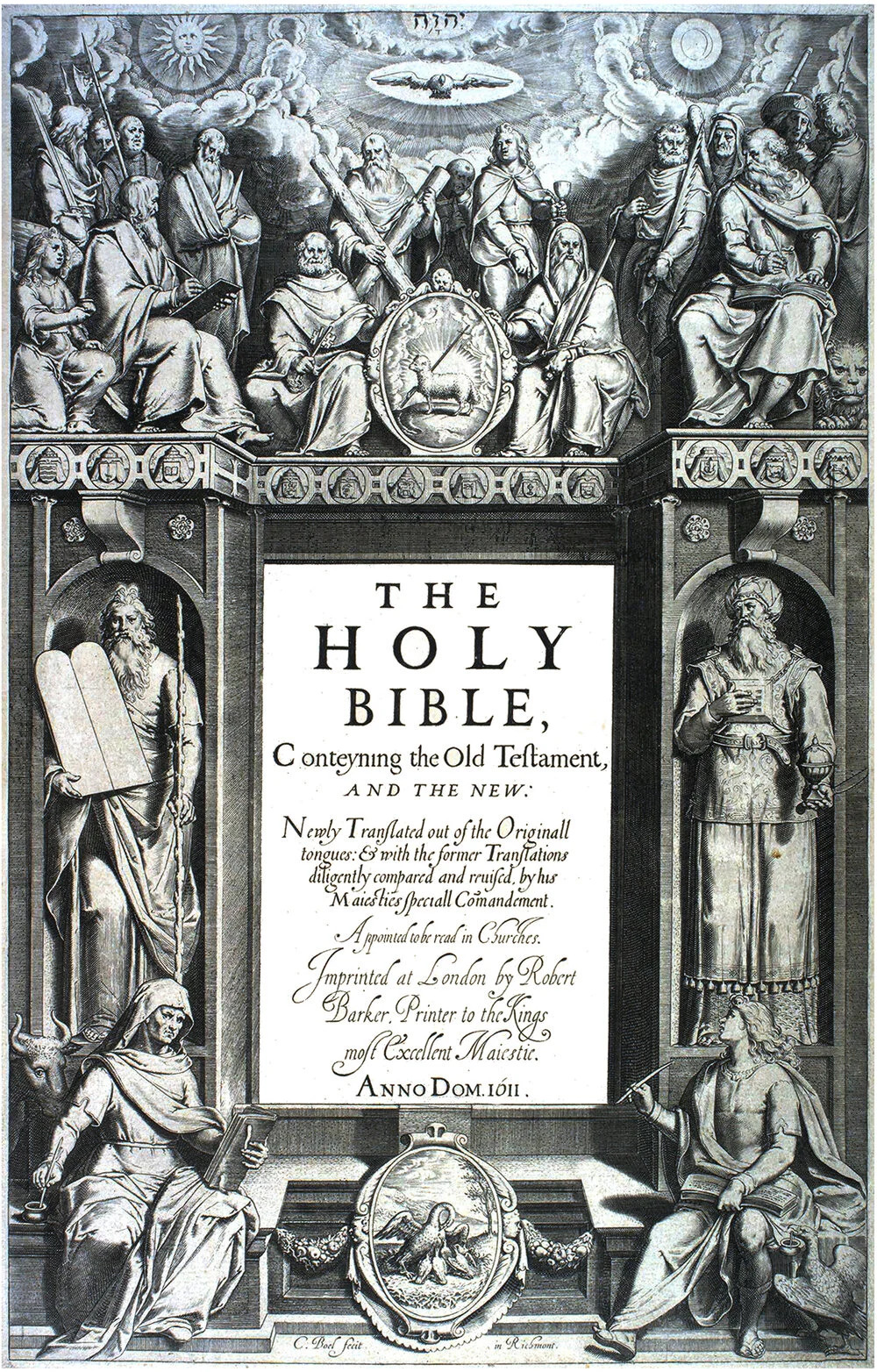
When the translators of the King James Version gathered in 1604, Fulke's parallel edition was among the most widely circulated English New Testaments in existence. Ward Allen's research, documented in English Bible Versions and his 1969 study, found that in the Gospels alone, roughly one quarter of the proposed amendments to the text adopted readings first found in the Rheims translation. The Catholic Bible had become, without anyone planning it that way, one of the working texts of the Protestant masterpiece.
The Specific Borrowings
The debt repays close attention. A sample from three chapters, taken by chance:
- Matthew 26:26
blessed
appears first in the Rheims; the KJV keeps it. - Matthew 26:30
hymn
is the Rheims word; the KJV follows. - Matthew 26:63
adjure
enters English through the Rheims; the KJV follows. - James 1:5
upbraideth not
appears first in the Rheims and passes into the KJV. - James 1:21
engrafted word
is the Rheims phrase; the KJV adopts it. - James 1:26
bridleth not
is the Rheims word; the KJV follows.
As Barker noted, examining those three chapters yielded such results that the reader will not doubt that very many examples of the same description might be produced.
Borrowings from the Epistles
The same pattern extends through the Epistles. Ward Allen's research identified Rheims influence across the Pauline letters, where the King James translators repeatedly considered and adopted Rheims readings in their revision notes:
- Romans 5:11: The Rheims gives "reconciliation," translating the Vulgate's "reconciliationem." The KJV follows.
- 1 Corinthians 13:12: The Rheims gives "face to face" for Jerome's "facie ad faciem." The KJV follows.
- Hebrews 11:1: The Rheims gives "substance of things to be hoped for" for "substantia sperandarum rerum." The KJV's "substance of things hoped for" is nearly identical.
- 1 Corinthians 13:3: The Rheims gives "charity" for "caritatem" consistently throughout the chapter. The KJV follows in every instance.
In each case, the King James translators had access to the Rheims text through Fulke's 1589 parallel edition, and the evidence of their revision notes shows them explicitly considering and frequently adopting Rheims readings. The Catholic translation's influence on the Protestant masterpiece is not a matter of inference but of documented revision history.
Cardinal Newman later traced the irony a step further: the influence did not run only one way. When Bishop Challoner revised the Douay-Rheims text in the eighteenth century, Newman observed, the revision moved the Catholic Bible's own wording closer to the King James Version it had once helped to shape. The KJV translators named the Rheims New Testament in their preface. They drew on it extensively. The translation made by Catholic scholars in exile, illegal in England, circulated primarily through a Protestant refutation, had shaped the language of the most widely read English Bible in history.
The Greek Article
The Rheims New Testament's handling of the Greek Article drew admiration from scholars long after its publication. William Moulton, examining the text carefully, found more than forty instances where the Rheims New Testament alone, among all English versions from Tyndale to the Authorized Version, correctly represents the Greek Article. He noted that this was remarkable given that the other translators were certainly known to and used by the Rheims scholars: "They make no allusion in their preface to any indebtedness to preceding translators, but of the fact there can be no doubt."
This precision in handling the Article was not a stylistic accident. Gregory Martin and his colleagues were Oxford-trained classicists working from a text they knew intimately. Their attention to the Greek original, even while formally translating from the Latin Vulgate, gave their New Testament a scholarly rigour that Protestant translators found useful even as they dismissed the translation as a whole.
The Vocabulary Legacy
Beyond individual phrases, the Rheims New Testament contributed something more lasting: vocabulary. The words through which English speakers discuss Christian faith entered the language through Saint Jerome's Vulgate, and entered English through translations that followed the Vulgate closely. H. W. Hoare, writing on the English Bible versions, listed the terms that Saint Jerome gave to the Church: "Scripture, communion, grace, sanctification, justification, spirit, salvation, glory, congregation, penance, propitiation, conversion, election, sacrament, elements, discipline, eternity." All come from Saint Jerome's Bible. The Rheims translators were the most rigorous carriers of this vocabulary into English, and through their influence on the KJV translators, these terms became the common inheritance of English-speaking Christianity.
Hoare drew a fair conclusion: "were we under no other obligation to the editors than that they helped to encourage a better acquaintance with Saint Jerome's Vulgate, our debt to them would still be great."
A Measured Assessment
The assessment of Gregory Martin's work that has best survived the passage of time belongs to William Moulton, who examined it without partisanship. "Nothing is easier," he observed, "than to accumulate instances of the eccentricity of this version, of its obscure and inflated renderings; but only minute study can do justice to its faithfulness and to the care with which the translators executed their work. Every other English version is to be preferred to this, if it must be taken as a whole; no other English version will prove more instructive to the student who will take the pains to separate what is good and useful from what is ill-advised and wrong."
H. W. Hoare, arriving at the same conclusion from a different direction, wrote that "the Douai Version has one great merit, which is wanting in our Authorized Version, namely, that it holds fast to the principle of uniformity in its renderings whenever this principle is not prejudicial to the sense. Moreover, for serious students, it is just the uncompromising fidelity of the translators to their Vulgate, which in its New Testament carries us back to the Old Latin rendering of Greek manuscripts current in the middle of the second century, that gives to the Rheims Edition so considerable a value for the purposes of textual criticism."
Sources
- Henry Barker, English Bible Versions: A Tercentenary Memorial of the King James Version; primary source for the specific KJV borrowings, Moulton, and Hoare
- Ward Allen, research cited in the existing About the Douay-Rheims Bible page; one quarter of Gospel amendments adopted Rheims readings
- Cardinal John Henry Newman,
The History of the Text of the Rheims and Douay Version of Holy Scripture,
in Tracts Theological and Ecclesiastical
← A Bible Forbidden to Its Own Readers · The Challoner Revision →