Multiple Editions, No Single Text
The history of Douay-Rheims Bible editions after Challoner is a history of proliferation without control. When Richard Challoner revised the Douay-Rheims between 1749 and 1777, he produced not one text but several, each differing from the last, each published anonymously, with no mechanism for determining which should be considered definitive. By the time he died in 1781, the Catholic English Bible existed in at least three distinct Challoner versions, none formally authorized, none identical with the others.
What followed made the situation considerably more complex.
McMahon, Troy, and the Irish Revisions
In 1783, a Dublin priest named Bernard MacMahon, at the request of Archbishop Carpenter of Dublin, undertook a further revision of Challoner's New Testament. MacMahon's text introduced more than five hundred changes in some sections, departing from what the Catholic Dictionary later described as Challoner's Protestant leanings. Eight years later, in 1791, MacMahon was engaged again, this time by Carpenter's successor Archbishop Troy, to collate the entire Bible with the Clementine Vulgate; the result became known as Dr. Troy's Bible. In 1794, and again in 1803 and 1810, further New Testament printings appeared, each claiming the Challoner lineage while differing in significant respects from his actual text.
Cotton's Catalogue
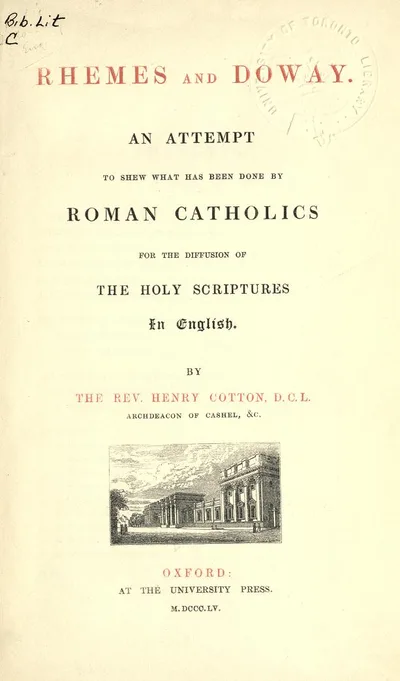
Henry Cotton, an Archdeacon of Cashel who spent years cataloguing every Catholic English Bible edition he could locate, published his findings at the Oxford University Press in 1855. His preface captured the problem with precision. Educated men, he wrote, whether Protestant or Catholic, allowed themselves to speak of "the Douay Bible" or "the Rhemish Testament" as though all copies of Holy Scripture circulating among Catholics represented one and the same text, accompanied by one and the same body of notes. They did not. Cotton's chronological list ran to well over a hundred entries spanning more than two and a half centuries.
By the mid-nineteenth century, Newman's own analysis identified four competing text traditions in active use. The Murray and Denvir line, followed in Ireland, traced its descent from Challoner's earlier editions. The Wiseman and Haydock line, used in England and America, followed either Dr. Troy's revision or the later Challoner texts. The Haydock Bible, edited by the Rev. George Leo Haydock and published in Manchester in 1811-12, was notable for its new and copious annotations, compiled from the writings of eminent commentators to replace the polemical notes Challoner had removed. Gibson's editions, published in Liverpool from 1816, represented yet another editorial position.
The Roman Catholic Bible Society
In 1815, the Roman Catholic Bible Society published its own edition in London, then issued a second, slightly different edition the same year. Cotton found the existence of this Society itself largely unknown: "the account of the curious and important proceedings of the Roman Catholic Bible Society, about forty years ago, the very name and existence of which Society are unknown to nineteen persons out of twenty at this day."
Newman's Analysis
Cardinal Newman, surveying this landscape in his tract on the Rheims and Douay Version, observed that the Old Testament had remained essentially stable since Challoner's 1750 revision as described in The Challoner Revision, while the New Testament had become a field of competing readings. Editors were forced to choose between this or that of Challoner's three New Testament texts, or MacMahon's revision as refined by Troy. No two editions were identical, yet all were published under the same name. Newman identified approximately one hundred and seventy textual variations in a sample of seventy verses between the pre-Challoner Douay Old Testament and Challoner's revision of it.
Independent Translators
Individual scholars meanwhile attempted fresh translations. Dr. Geddes, a Catholic priest, began a new translation from the original languages in 1792, concluding after reflection that patching and piecing what had already been pieced and patched would produce only a strange composition. He did not complete it. Dr. Lingard, the historian, translated the four Gospels in 1836. Bishop Francis Patrick Kenrick of Philadelphia published the four Gospels in 1849, followed by the rest of the New Testament and the Apocalypse in 1851, and then volumes of the Old Testament: a substantial scholarly achievement.
An Abuse of Terms
Cardinal Wiseman put the situation plainly: "To call it any longer the Douay or Rhemish version is an abuse of terms. It has been altered and modified till scarce any verse remains as it was originally published."
Cotton's concluding question was direct: whether there existed at that moment any authorized standard text of the Catholic English Bible, or any such thing as a uniform interpretation of it. His answer was implicit in every page of his chronological list. There was not. What passed under the name of the Douay-Rheims Bible was a family of related texts, shaped by successive editors over two and a half centuries, each one departing further from the original work of Gregory Martin and his colleagues at Rheims.
The text presented on this site is Martin's original: the first edition pre-Challoner Douay-Rheims, the translation that all subsequent editors took as their starting point and that none of them left unchanged. For a full account of what this site presents, see About the Douay-Rheims Bible.
Sources
- Cardinal John Henry Newman,
The History of the Text of the Rheims and Douay Version of Holy Scripture,
in Tracts Theological and Ecclesiastical; primary source for Newman's analysis of the post-Challoner text traditions - Rev. Henry Cotton, Rhemes and Doway: An Attempt to Shew What Has Been Done by Roman Catholics for the Diffusion of the Holy Scriptures in English (Oxford University Press, 1855); primary source for the chronological edition list, Cotton's preface, and the Roman Catholic Bible Society
- Henry Barker, English Bible Versions: A Tercentenary Memorial of the King James Version; cites the Catholic Dictionary on McMahon's revision and Wiseman's collected essays