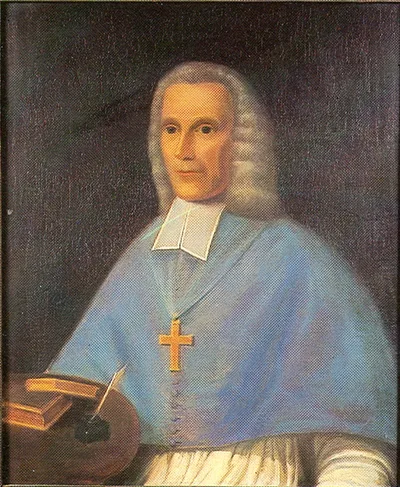
Bishop Richard Challoner
Richard Challoner (1691–1781) was a convert to Catholicism who rose to become the Vicar Apostolic of the London District, effectively the senior Catholic bishop in England during one of the most difficult periods for English Catholics. Appointed coadjutor in 1741 and taking full charge in 1758, he shepherded a persecuted community with quiet determination for over four decades.
Among his many pastoral works, Challoner undertook a thorough revision of the Douay-Rheims Bible. By the mid-eighteenth century, the original text was over a hundred and fifty years old. Its heavily Latinate vocabulary, archaic phrasing, and dense annotations made it increasingly difficult for ordinary readers. Challoner set out to make the Bible accessible to the Catholics of his own day.
What He Changed
Challoner's revision was far more extensive than a simple modernization of spelling. Working with the Carmelite friar Francis Blyth, he undertook several kinds of changes:
- Simplified vocabulary: The original's distinctive Latinate terms were replaced with more familiar English equivalents: exinanited (Philippians 2:7) became "emptied himself," contristate (Ephesians 4:30) became "grieve," and longanimity (Romans 2:4) became "longsuffering."
- Modernized phrasing: Archaic constructions and obsolete expressions were rewritten for clarity.
- Corrected against the Vulgate: Challoner checked the translation against the Clementine Vulgate and, in practice, against the wording of the King James Version, though his title pages also claimed comparison with the Greek and Hebrew.
- Stripped the annotations: The original's extensive theological notes, designed to counter Reformation arguments, were largely removed, producing a compact single-volume edition that was far more practical for everyday use.
Cardinal Newman observed that Challoner's finished text is even nearer to the Protestant than it is to the Douay
, not in grammatical structure but in phraseology and diction, despite both being revisions of
the same Vulgate. The Catholic Dictionary noted the same: "he has sacrificed force and vividness
in some of his changes."
Multiple Editions
Challoner did not produce a single definitive revision. He issued several editions over more than two decades, each differing from the last. Readers can compare Martin's original with Challoner's revised New Testament directly on this site.
- 1749: First revised New Testament
- 1750: Complete Bible, differing from the 1749 New Testament in about 124 passages
- 1752: Further New Testament revision, with over two thousand readings differing from the 1750 edition
All of these editions were published anonymously. It remains unclear to what extent Challoner was personally involved in every change across the later editions, or whether some alterations were introduced by others in the editorial process.
Examples of Changes
The scope of Challoner's alterations becomes clear when specific passages are set alongside the Vulgate Latin that both translators were working from. In nearly every case, Martin's English mirrors Saint Jerome's Latin word for word; that fidelity is precisely why Challoner felt it needed to change.
Ephesians 3:6
Vulgate: gentes esse cohæredes, et concorporales, et comparticipes promissionis ejus in Christo Jesu per Evangelium
Literal translation: the Gentiles to be co-heirs, and co-bodied, and co-partakers of his promise in Christ Jesus through the Gospel
Original: "The Gentiles to be coheirs and concorporate and comparticipant of his promise in Christ Jesus by the Gospel"
Challoner: "That the Gentiles should be fellow heirs, and of the same body, and co-partners of his promise in Christ Jesus, by the gospel"
Martin coined "concorporate" directly from Saint Jerome's concorporales and "comparticipant" from comparticipes — words that have no prior existence in English but map exactly onto the Latin compounds. Challoner dissolved them into natural phrases.
Ephesians 3:9
Vulgate: et illuminare omnes, quæ sit dispensatio sacramenti absconditi a sæculis in Deo, qui omnia creavit
Literal translation: and to enlighten all, what is the dispensation of the mystery hidden from the ages in God, who created all things
Original: "and to illuminate all men what is the dispensation of the sacrament hidden from worlds in God, who created all things"
Challoner: "and to enlighten all men, that they may see what is the dispensation of the mystery which hath been hidden from eternity in God, who created all things"
Two changes in a single verse. Saint Jerome used sacramentum throughout his translation to render the Greek μυστήριον; Martin followed the Latin word and gave "sacrament." Challoner returned to the Greek meaning and gave "mystery." Saint Jerome's a sæculis (literally "from the ages" or "from the worlds") became Martin's literal "from worlds" and Challoner's smoother "from eternity."
Romans 8:15
Vulgate: Non enim accepistis spiritum servitutis iterum in timore, sed accepistis spiritum adoptionis filiorum, in quo clamamus: Abba (Pater)
Literal translation: For you have not received the spirit of servitude again in fear, but you have received the spirit of adoption of sons, in whom we cry: Abba (Father)
Original: "you have not received the spirit of servitude again in fear; but you have received the spirit of adoption of sons, wherein we cry: Abba, (Father)"
Challoner: "you have not received the spirit of bondage again in fear; but you have received the spirit of adoption of sons, whereby we cry: Abba (Father)"
A single word changed: servitutis (servitude) became "bondage." Martin's choice is a direct rendering of the Latin; Challoner's is the more natural English idiom for the same idea.
Isaiah 40:22
Vulgate: Qui sedet super gyrum terræ, et habitatores ejus sunt quasi locustæ; qui extendit velut nihilum cælos, et expandit eos sicut tabernaculum ad inhabitandum
Literal translation: Who sits above the circle of the earth, and its inhabitants are as locusts; who stretches out the heavens as nothing, and spreads them out as a tent for dwelling
Original: "He that sitteth upon the compass of the earth, and the inhabitants thereof are as locusts: he that stretcheth out the heavens as nothing, and spreadeth them as a tent to dwell in"
Challoner: "It is he that sitteth upon the globe of the earth, and the inhabitants thereof are as locusts: he that stretcheth out the heavens as nothing, and spreadeth them out as a tent to dwell in"
Gyrus (from the Greek γῦρος) means a ring, a circle, or a circular arc; it does not denote a sphere. Martin's "compass," understood in its older sense of a circular arc or circuit, renders gyrum faithfully. Challoner's "globe" introduces a three-dimensional object Saint Jerome's Latin does not specify.
These are not isolated cases. By the time Challoner's successors had added their own revisions, the accumulated distance from Gregory Martin's original would lead Cardinal Wiseman to question whether the name "Douay-Rheims" still applied at all, a question taken up in the next article.
Almost a New Translation
The cumulative effect of Challoner's changes was dramatic. Cardinal John Henry Newman, writing
in Tracts Theological and Ecclesiastical, observed that the revisions to the Old Testament issue in little short of a new translation,
and that Challoner's version was even nearer to the Protestant than it is to the Douay
in phraseology and diction, despite both
being translations of the same Latin Vulgate. In many passages, the Challoner text reads so differently
from Gregory Martin's original that they are barely recognizable as the same work.
Nearly every "Douay-Rheims Bible" in print today is actually the Douay-Rheims-Challoner revision, not the original text of 1582 and 1609–1610.
This distinction is often overlooked. When Catholics speak of "the Douay-Rheims Bible," they almost invariably mean Challoner's version. The original text, with its Latinate richness, its close fidelity to the Vulgate, and its extensive polemical annotations, has been largely forgotten.
What Was Lost: The Names
Among the least-noticed but most theologically significant of Challoner's changes was his treatment of the name of Christ in Old Testament passages. The Catholic Encyclopedia (1913) quotes Cardinal Wiseman, who was direct on the scope of the intervention: Challoner's changes were "so considerable that scarcely any sense remains as it was originally published."
The Vulgate Latin uses the word "christum," the Latin rendering of the Greek christos, in several Old Testament passages where the Hebrew original has "mashiach." Gregory Martin followed Jerome's Latin and rendered these as "his Christ," "the Christ of the Lord," or "the Lord's Christ," preserving the Christological resonance that Jerome intended and that the Council of Trent's declaration of Vulgate authenticity had sanctioned. Challoner, working toward a more natural English idiom, replaced these with "his anointed" or "the anointed of the Lord."
The difference is not trivial. In 1 Kings 12:5, the original Douay-Rheims gives: "the Lord is witness against you, and his Christ is witness this day, that you have not found ought in my hand." Challoner's version reads: "the Lord is witness against you, and his anointed is witness this day, that you have not found any thing in my hand." The typological link to Christ is present in Martin's text; in Challoner's it is dissolved into a description. The same pattern recurs throughout the Old Testament wherever the Vulgate uses "christum" in a Messianic context.
For readers who wish to examine the differences in detail, realdouayrheims.com presents the case for the original text with further examples, and originaldouayrheims.com/differences provides a systematic account of the changes Challoner introduced. This site presents the original pre-Challoner text: Gregory Martin's translation, unaltered.
Why the Original Matters
The pre-Challoner Douay-Rheims is not merely an antiquarian curiosity. It is the work of men who translated under extraordinary circumstances: scholars in exile, some of whom would be martyred, producing a translation of the entire Bible in under two years while simultaneously training priests for a mission that could cost them their lives.
The original text reflects a different philosophy of translation, one that prioritized fidelity to the Latin source even at the cost of readability. Where Challoner smoothed and simplified, Martin and his colleagues preserved the texture of the Vulgate: its cadences, its theological precision, its occasionally difficult beauty.
This site presents that original text, with only light modernization of spelling and punctuation. The translation itself, Gregory Martin's translation, is unaltered.
Sources
- Cardinal John Henry Newman,
The History of the Text of the Rheims and Douay Version of Holy Scripture,
in Tracts Theological and Ecclesiastical - Henry Barker, English Bible Versions: A Tercentenary Memorial of the King James Version — cites the Catholic Dictionary on Challoner
- Rev. Henry Cotton, Rhemes and Doway: An Attempt to Shew What Has Been Done by Roman Catholics for the Diffusion of the Holy Scriptures in English (Oxford University Press, 1855) — chronological list of editions
← How the Douay-Rheims Shaped the King James Bible · After Challoner: A Bible in Dispute →