From Caution to Invitation
Catholic Bible reading has a history more varied than the myth of a Church that kept Scripture from its people. An earlier article in this collection, A Bible Forbidden to Its Own Readers, described the period when Catholics who produced the Rheims New Testament required their own readers to obtain a license before opening it. That history is real, and it requires explanation, but it does not represent the Church's settled mind on Scripture. The restrictions that marked certain periods were pastoral responses to specific crises: the proliferation of tendentious translations, the fracturing of Christian unity, the real danger that unsupported private reading of Scripture would lead ordinary Catholics into the doctrinal traps that polemicists had carefully laid. When those conditions changed, the restrictions changed with them.
The trajectory of Catholic teaching has moved, consistently and deliberately, toward wider access and warmer encouragement. Pope Leo XIII in 1893 urged Catholics to study Scripture with scholarly rigor. Pope Pius XII in 1943 authorized translation from the original languages, opening the way to a new generation of Catholic Bibles. The Second Vatican Council's Dogmatic Constitution on Divine Revelation, Dei Verbum, issued in 1965, brought this trajectory to its fullest expression and placed the Church's invitation to Scripture reading at the center of Catholic life; as the Catholic Encyclopedia (1913) records, this development had deep roots in the Church's tradition.
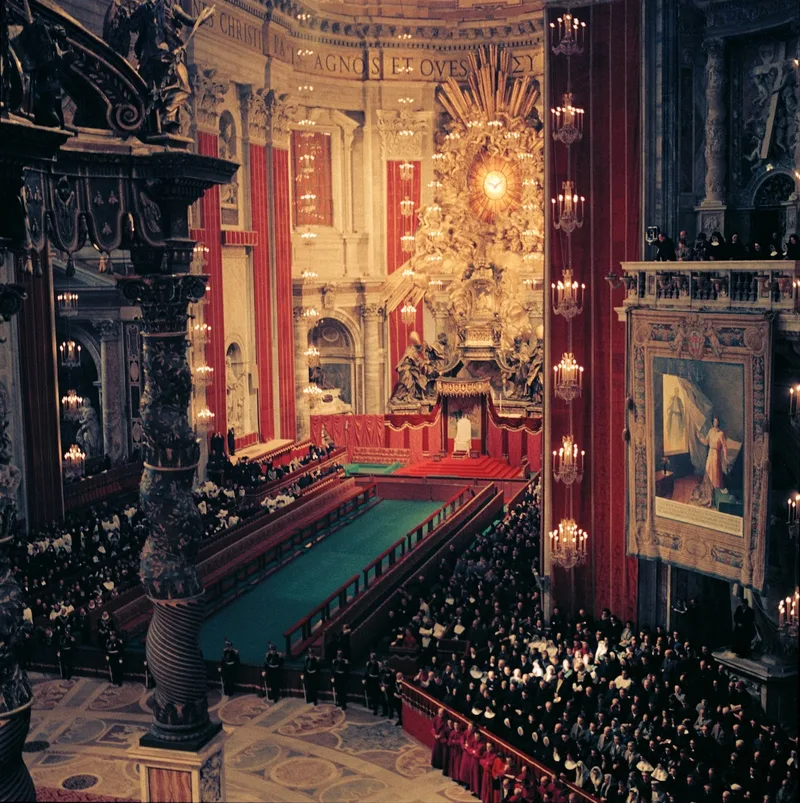
Dei Verbum: The Open Door
Before Dei Verbum says anything about access or translation, it establishes the theological ground for everything that follows. Divine revelation, the Council declares at the outset, is not the transmission of doctrines from a remote authority but an address from a friend. God, as the document puts it, "spoke to men as friends" (DV 2), drawing humanity into a relationship of intimacy rather than mere instruction. Reading Scripture is re-entering that address; the reader is not a student working through a text but a friend receiving a word spoken personally to them.
The twenty-fifth article of Dei Verbum is among the most directly pastoral passages in the documents of Vatican II. It addresses every member of the Church, from scholars to the faithful in the pews, and it speaks without qualification:
Easy access to Sacred Scripture should be provided for all the Christian faithful. For this reason the Church from the very beginning accepted as her own that very ancient Greek translation of the Old Testament which is called the Septuagint; and she has always given a place of honor to other Eastern translations and Latin translations, especially the Latin translation known as the Vulgate. But since the Word of God should be accessible at all times, the Church by her authority and with maternal concern sees to it that suitable and correct translations are made into different languages...
The same article quotes Saint Jerome directly: "Ignorance of the Scriptures is ignorance of Christ." It calls on all the faithful to "learn by frequent reading of the divine Scriptures the excellent knowledge of Jesus Christ," and it places Scripture reading alongside prayer as indispensable to Christian life: "Let them remember that prayer should accompany the reading of Sacred Scripture, so that God and man may talk together; for 'we speak to Him when we pray; we hear Him when we read the divine sayings.'"
The document describes Sacred Scripture as the pure and everlasting source of spiritual life
and calls for it to nourish the faithful alongside the Eucharist. Both form, in Dei Verbum's image, a single table: "the bread of life" from the table of God's word
and from the table of Christ's body.
How to Read: The Church's Guidance
The Church's encouragement of Scripture reading comes with a framework for reading well. The Catechism of the Catholic Church, drawing on Dei Verbum, sets out three criteria that govern Catholic interpretation of Scripture.
- Attention to authorial intent. Sacred Scripture speaks through human writers
with particular intentions, literary forms, and audiences.
Truth is differently presented and expressed in the various types of historical writing, in prophetical and poetical texts, and in other forms of literary expression
(CCC 110). A passage of Hebrew poetry is read differently from a legal code; a prophetic oracle calls for different attention than a genealogy. - Reading within the unity of Scripture. No verse stands alone. The Old and New
Testaments form a single revelation: as Saint Augustine wrote,
the New Testament lies hidden in the Old and the Old is unveiled in the New.
Reading Scripture within its whole prevents both the isolation of proof texts and the misreading of difficult passages whose meaning becomes clear only in relation to the rest of what God has revealed. - Reading within the living Tradition of the Church. The Catechism (CCC 113)
draws on the Fathers in expressing this:
Sacred Scripture is written principally in the Church's heart rather than in documents and records; for the Church carries in her Tradition the living memorial of God's Word.
The Magisterium serves as the authoritative interpreter of Scripture, not because it stands over the Word of God, but because it serves it.
These three criteria work together as a single interpretive discipline. Pope Leo XIV, in his
2026 catechesis on Dei Verbum, drew on Benedict XVI's formulation to express their
unity: Authentic biblical hermeneutics can only be had within the faith of the Church.
The practical test for any reading comes from Augustine, cited in that same catechesis: a convincing
interpretation is one that builds up the twofold love of God and neighbor.
Where an interpretation
serves charity and deepens faith, the reader is on firm ground; where it divides, isolates, or abstracts
the text from the community that lives by it, something has gone wrong.
These three criteria are not restrictions on the reader. They are a map. They describe what Scripture actually is: a human and divine document, embedded in a tradition, addressed to a community, and best understood within that community's accumulated wisdom.
Lectio Divina
The method the Church most commends for personal Scripture reading is lectio divina, divine reading. It is an ancient practice, rooted in the monasticism of the early centuries, and it has been consistently endorsed by popes and councils as the proper disposition for engaging the Word of God.
- Lectio attentive reading: taking a passage slowly, allowing the words to land, not rushing past difficulty.
- Meditatio meditation: staying with a phrase or image that arrests the attention, turning it in the mind, listening for what it opens.
- Oratio prayer: speaking to God from what has been heard, bringing the text into direct conversation with the life of the reader.
- Contemplatio contemplation: resting in God's presence, beyond words, in the quiet that reading and prayer have prepared.
Pope Benedict XVI, in his 2010 apostolic exhortation Verbum Domini, endorsed lectio divina as a privileged method for encountering the living Word. Drawing on Saint
Gregory the Great, he quoted: The divine words grow together with the one who reads them.
The
practice, Benedict wrote, allows Scripture to become not simply a word from the past but a living
and timely word addressed to the particular reader in the particular moment of their life.
Reading the Douay-Rheims with Lectio Divina
The Douay-Rheims was translated for devotional reading, not rapid comprehension. Gregory Martin and his colleagues at Douai and Reims worked from the Latin Vulgate, and their English follows Vulgate phrasing closely enough that a reader familiar with the Latin hears the same cadences in both. This deliberate closeness to Jerome's text, including its Latinate diction and syntactic weight, slows the reader down. That slowness is not a defect. It is what lectio divina requires. A translation calibrated for swift modern reading moves too fast for the kind of attentive dwelling that meditatio depends on; the Douay-Rheims, with its archaism and density, holds the reader at the pace the text itself sets. Readers who have prayed the Psalms or the Pauline epistles in this version often find that the unfamiliar phrasing arrests the attention in the same way a difficult line of poetry does, making space for the silence that contemplatio opens into.
A Tradition of Encouragement
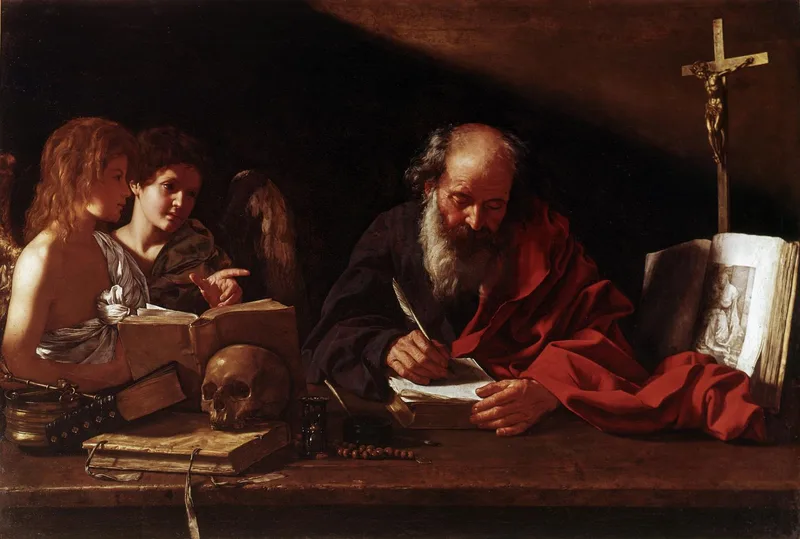
The Church's encouragement of Scripture reading is not a modern development. It runs through the entire tradition, from the Fathers forward. The passages in which Saint Jerome, Saint John Chrysostom, and Pope Saint Gregory the Great urged their contemporaries to read Scripture regularly and with persistence are among the warmest and most direct in patristic literature.
Saint Jerome, whose Latin Vulgate made Scripture accessible to the Western Church for a millennium, wrote to his correspondents with the urgency of a teacher who knew what was being missed: "Read assiduously and learn as much as you can. Let sleep find you holding your Bible, and when your head nods, let it fall on the sacred page." His maxim that "ignorance of the Scriptures is ignorance of Christ" passed from his letters into Dei Verbum itself and from there into the Catechism (CCC 133). The Psalms — the prayer book that Jerome translated and that every generation of the Church has prayed — illustrate why that urgency was warranted.
Saint John Chrysostom, who preached through entire books of Scripture to his congregations in
Antioch and Constantinople, wrote that "it is not possible ever to exhaust the mind of the
Scriptures. It is a well that has no bottom." Gregory the Great described the Bible in a phrase
that has stayed in the tradition ever since: a river in which a lamb may wade and an elephant may swim.
Its depths are inexhaustible; its shallows are accessible to everyone. "Learn the heart of God from
the word of God," he wrote to a friend.
The Continuing Call
The Church's invitation has only grown more explicit in the decades since Dei Verbum. In Verbum Domini (2010), Pope Benedict XVI called for Scripture to be integrated into every dimension of Catholic life: personal prayer, family life, parish community, theological study, and missionary work. He wrote that "the word of God is not simply a word from the past, but a living and timely word" and that the Church's deepening engagement with Scripture is essential to her identity and mission.
In 2019, Pope Francis went further in a practical direction. His apostolic letter Aperuit Illis instituted the Sunday of the Word of God, celebrated each year on the
Third Sunday in Ordinary Time, as a day specifically devoted to the celebration, study, and
living of Scripture. The Bible is the book of the Lord's people,
Francis wrote, "who, in listening to it, move from
dispersion and division towards unity." He invoked Saint Jerome's maxim again: "Ignorance of the Scriptures
is ignorance of Christ." The Catechism makes the same appeal (CCC 133), and the section on prayer
returns to it: "The Church strongly urges all the Christian faithful to learn the surpassing knowledge
of Jesus Christ by frequent reading of the divine Scriptures" (CCC 2653).
In 2026, Pope Leo XIV devoted his weekly general audiences to a sustained catechesis on Dei Verbum, working through the Council's vision of Scripture and Tradition over successive weeks. He opened the series with the document's first theological note, that God "spoke to men as friends," and developed it across addresses on the unity of Scripture and Tradition as a single living deposit, on the dual authorship of inspired texts, on the Church as Scripture's natural home, and on the inexhaustibility of God's Word. Saint Jerome's maxim returned in each session. Augustine's observation passed through the series as well: "There is only one Word that sounds on the lips of many saints." The catechesis, delivered to the faithful assembled in Saint Peter's Square, demonstrated in its very form what Dei Verbum had taught: the Word of God addressed to all, in the presence of all, for the life of all.
Scripture and This Site
The text on this site is Gregory Martin's original Douai-Rheims translation, produced in exile and published between 1582 and 1610, with only light modernization of spelling. It is a particular and distinctive rendering of Sacred Scripture, deeply shaped by its historical moment and by the translators' philosophical commitment to the Vulgate. That fidelity is explored in A Translation from the Authentic Latin. It is one way of hearing the Word of God in English.
The Church's invitation, expressed in Dei Verbum and confirmed in every subsequent magisterial document on Scripture, is to read. Whatever translation the reader uses, whatever method they bring to the text, the counsel of Saint Jerome, Saint Chrysostom, Pope Saint Gregory the Great, and the Council fathers is the same: open the book, come without haste, and let the words do their work.
Sources
- Second Vatican Council, Dei Verbum (1965), especially articles 12, 21, and 25
- Catechism of the Catholic Church, paragraphs 109–114 (reading Scripture well), 131–133 (Scripture in the life of the Church), and 2653 (Scripture and prayer)
- Cardinal John Henry Newman,
The History of the Text of the Rheims and Douay Version of Holy Scripture,
in Tracts Theological and Ecclesiastical - Pope Benedict XVI, Verbum Domini (2010)
- Pope Francis, Aperuit Illis (2019) — institution of the Sunday of the Word of God
- Saint Jerome —
Ignorance of the Scriptures is ignorance of Christ
; cited in Dei Verbum 25 and CCC 133 - Saint Gregory the Great —
Learn the heart of God from the word of God
; "The divine words grow together with the one who reads them"; cited in Verbum Domini 30 - Pope Leo XIV, General Audiences of January 14, 21, 28 and February 4, 11, 2026 — catechesis series on Dei Verbum
← From the Authentic Latin to the Original Tongues · Begin reading the Douay-Rheims Bible →