The Reader
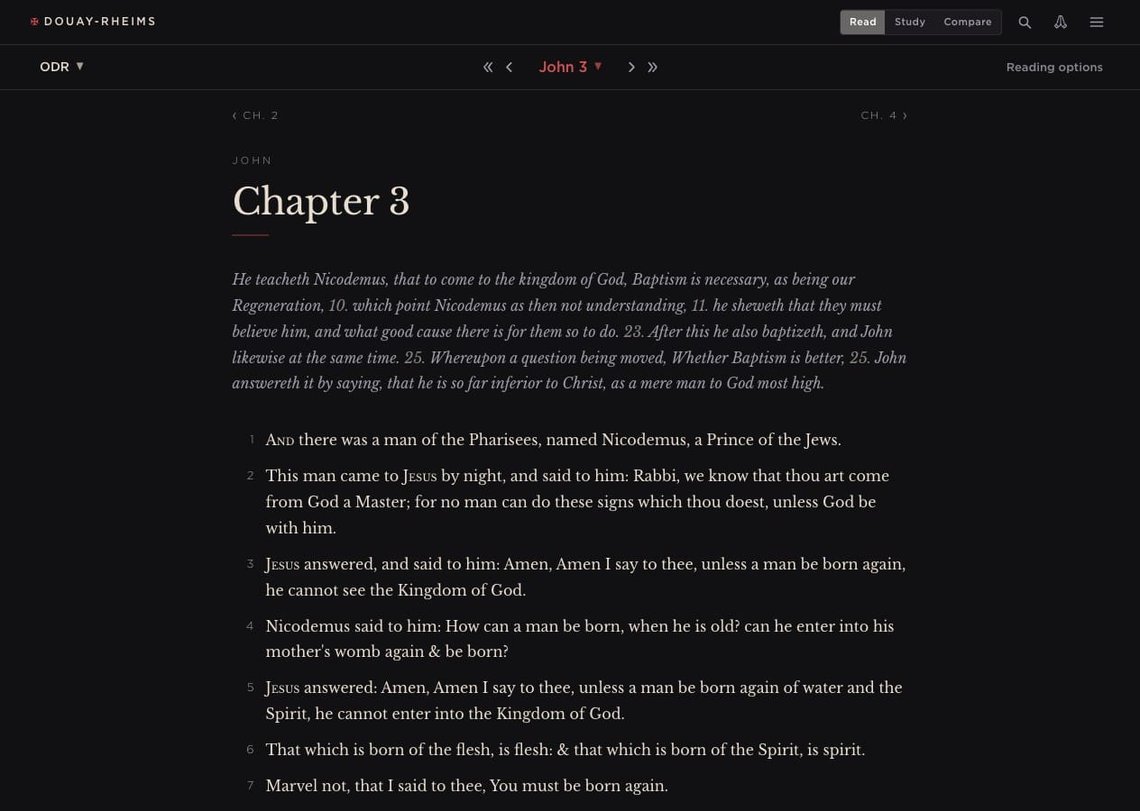
The top bar carries a mode selector with three options: Read, Study, and Compare. Read is the default. It presents the full text of all 76 books, with inline annotation markers, chapter arguments, and book introductions as they appeared in the original edition, with nothing to compete for attention.
Navigation is built into the chapter heading, which doubles as a dropdown for jumping directly to any chapter in the book. Four chevrons flank the heading:
- ‹ › – steps one chapter back or forward.
- ‹‹ ›› – jumps to the previous or next book entirely.
Infinite scroll is on by default: the next chapter loads seamlessly as you reach the bottom of the page, and the previous as you scroll back up. The chevron navigation and infinite scroll are independent: both can be active at once. Each can be toggled in the reading options to suit your preferred reading experience.
Study
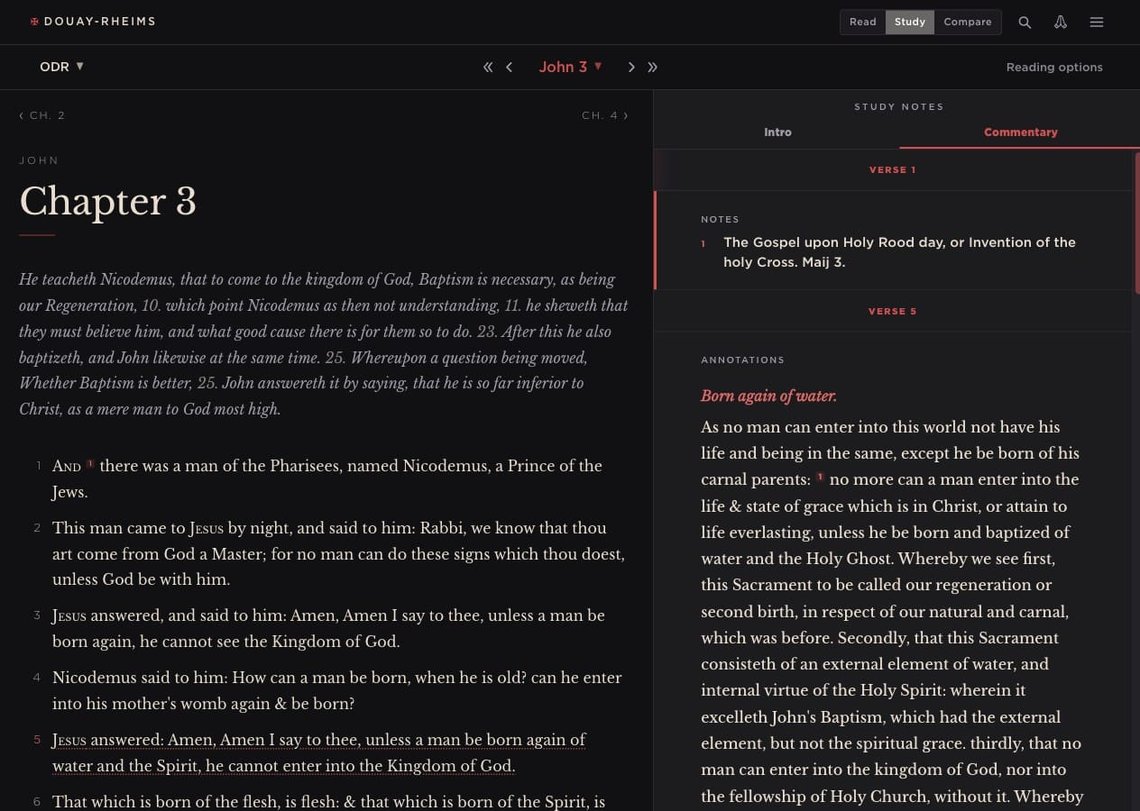
Study mode opens a side panel alongside the text. As you scroll, the panel tracks the current verse and surfaces the notes, commentary, and cross-references that belong to it. All of this material is reproduced exactly as the translators and commentators wrote it. Nothing has been added, removed, or modified.
Study Content by Translation
Six translations carry study content, each with its own character.
The Original Douay-Rheims carries 1,707 marginal annotations that form the theological heart of the translation, defending Catholic readings of Scripture, refuting Protestant renderings, and explaining the Latin behind the English word chosen. The doctrines most directly at stake are those the reformers contested: Christ's presence in the Eucharist, the intercession of the saints, and the nature of justification. Alongside the annotations are 3,709 scriptural cross-references drawn from the translators' own marginal notes, shorter textual notes on philology and alternative readings, book introductions and arguments, and occasional longer articles and end matter attached to specific chapters.
The Challoner Douay-Rheims (1752) includes Bishop Challoner's own footnotes and cross-references, which are more concise than the originals but remain a valuable companion to his revised text.
The Haydock Catholic Bible Commentary (1859) offers the most extensive study material on this site: verse-by-verse commentary for nearly every verse in Scripture, compiled by Rev. George Leo Haydock from the work of Challoner, Calmet, Tirinus, Menochius, and other Catholic commentators. Each entry is attributed to its author. The panel also includes book introductions and cross-references.
The Confraternity New Testament (1941) carries footnotes, brief commentary, and book introductions prepared by the scholars of the Episcopal Committee of the Confraternity of Christian Doctrine.
The Knox Bible (1955) includes Monsignor Knox's own translator notes, often witty and always illuminating, and the Catholic Public Domain Version includes translator notes by Ronald L. Conte Jr.
Linked References
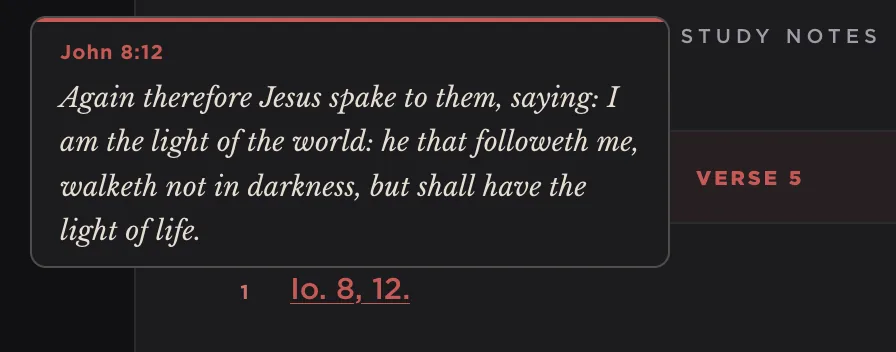
Scripture references within cross-references and notes are automatically detected and linked. Hovering over a linked reference shows a tooltip with the full verse text; clicking it navigates to the passage. Each verse header in the panel also doubles as a shareable link: hovering reveals a link icon, and clicking it copies a URL that opens directly to that verse's notes, cross-references, or annotations. Because the references were extracted programmatically from sixteenth- and seventeenth-century notation, a small number may not be detected or may resolve incorrectly.
The Panel
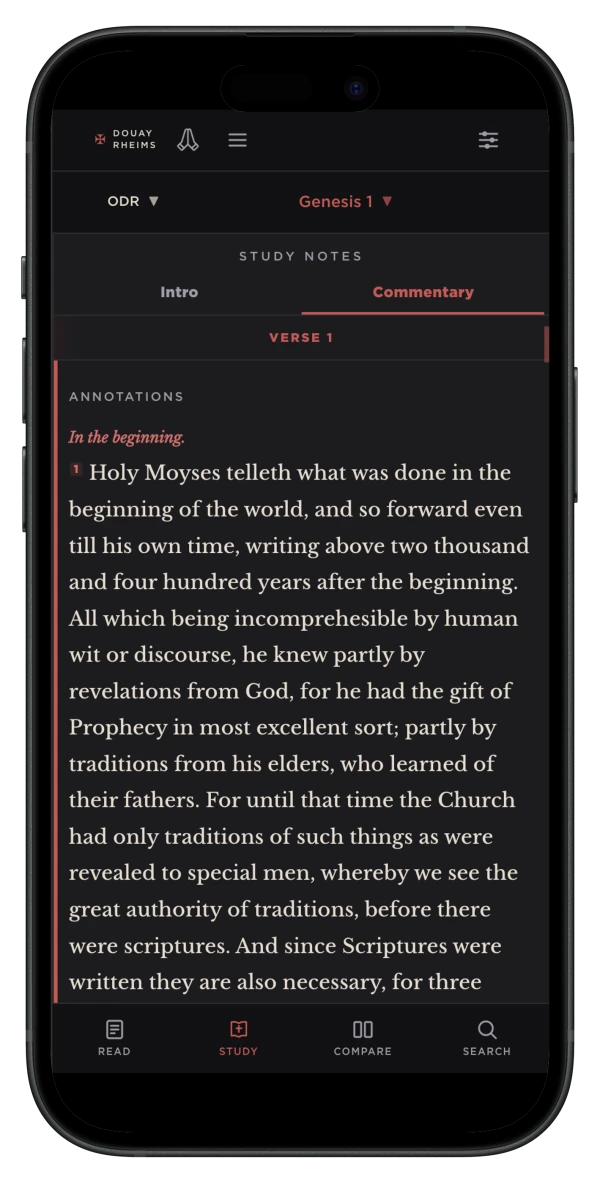
The panel can be resized by dragging the divider. On mobile it takes over the full screen, with the bottom bar switching between read, study, compare, and search views.
Compare
Any chapter can be placed alongside other translations for direct comparison. The most revealing comparison is with Bishop Challoner's revision of the Original Douay-Rheims itself. Setting the two texts side by side shows exactly what Challoner changed: where he simplified a Latinate construction, where he replaced the Original Douay-Rheims' vocabulary with a phrase borrowed from the King James Version, and where he left the original untouched. It is the clearest way to see what the Original Douay-Rheims actually is and what was lost in revision.
The King James Version is also available. It is relevant here less as a Protestant counterpart than as the source Challoner drew on when modernising the Original Douay-Rheims' English. Reading the three texts together, Original Douay-Rheims alongside Challoner alongside KJV, traces that influence directly. The Revised Standard Version Catholic Edition is planned as a further modern reference.
Up to seven translations can be displayed at once. Column headers can be grabbed and dragged to reorder the columns as needed. Hovering over a verse highlights the entire row across all columns, making it easier to track the same verse across translations.

Church Fathers
Every chapter of Scripture has a fourth mode alongside Read, Study, and Compare: a panel of patristic commentary drawn from the first eight centuries of the Church. The writers represented range from Clement of Rome and Ignatius of Antioch through Augustine, Chrysostom, Jerome, and Gregory the Great, with coverage spanning East and West, Greek and Latin traditions. Each entry shows the author's name, approximate date, and the passage under comment.
Commentary is organised by chapter. Within a chapter, entries are grouped by pericope, the natural unit of text the Fathers typically addressed. Clicking any verse number or pericope heading scrolls the commentary panel to the corresponding group. Where a Father comments on a single verse in isolation, that entry appears under its verse; where the comment ranges across several verses, it appears under the pericope that contains them.
Each entry card can be expanded to reveal inline footnotes and the source reference. The footnotes supply textual variants, parallel passages, and the editor's clarifications. The source line at the foot of each card gives the standard citation for the patristic text: the volume and column in Migne's Patrologia Graeca or Patrologia Latina, or the equivalent critical series. Bible references within the commentary text are linked: hovering over one shows the verse text in a small popover, the same tooltip used in study mode.
The panel includes filters for narrowing by century, era, theological tradition, or individual author. These can be combined: selecting the third century and the Greek East, for example, isolates the Alexandrian commentators on any given chapter. Filtered entries update immediately without reloading.
Reading Options
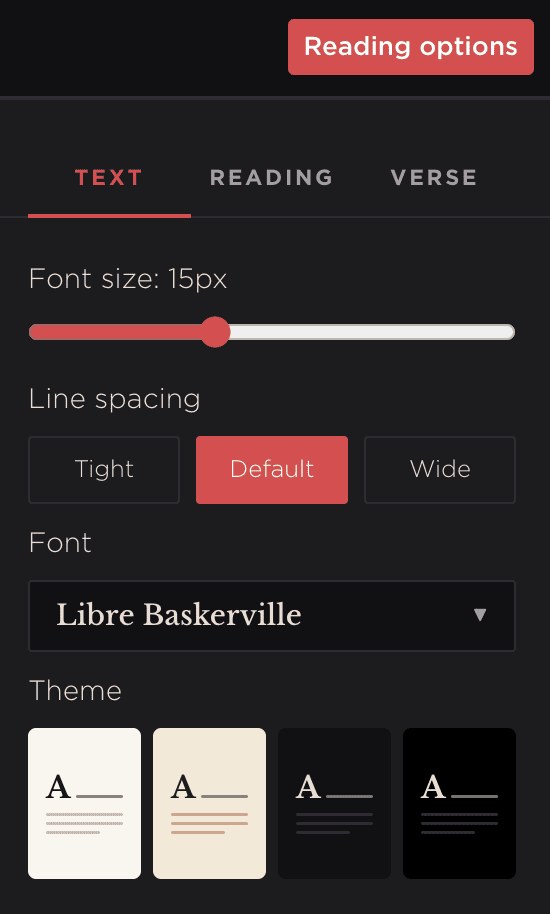
Typography
- Font: Six typefaces are available across two groups:
- Libre Baskerville (default): transitional serif. High contrast between thick and thin strokes, vertical stress, refined bracketed serifs. The classic book type style that bridges Renaissance calligraphy and the precision of the modern press.
- Sentinel: slab serif. Thick block-like serifs, sturdy and even-stroked. Where transitional serifs are refined, slabs are confident and grounded.
- Source Serif: humanist serif. Warmer and more calligraphic, proportions drawn from Renaissance letterforms. Highly readable on screen.
- Noto Sans: humanist sans-serif. Retains the warmth and varied stroke weight of calligraphic letterforms, without the serifs. Neutral and legible.
- Libre Franklin: grotesque sans-serif. Based on the American Gothic tradition: utilitarian, sturdy, with just enough character to avoid feeling mechanical.
- Montserrat: geometric sans-serif. Letters built on circles and straight lines. Clean, modern, and visually even.
- Size and spacing: Font size, line height, and column width are each adjustable in small steps, so the text can be set for comfortable reading on any screen.
Display
- Verse numbers: Can be shown or hidden. Hidden, the text reads more naturally as continuous prose.
- Paragraph view: Arranges the text in flowing paragraphs rather than numbered lines, as the original printed book appeared. Two sub-options are available: Drop cap renders the first letter of each chapter as a large decorative capital, and Hanging verse numbers pulls each paragraph-opening verse number into the left margin so the text body remains flush throughout.
- Italics: Words italicised in the original are those supplied by the translators to complete the sense in English but absent from the Latin. The toggle lets you distinguish these from the text proper, or read without the interruption.
- Small caps: Used in the original for important proper nouns and significant passages. Can be turned off for a more uniform appearance.
- Ampersand: The original uses & throughout. A toggle expands these to and for modern readability.
Accessibility
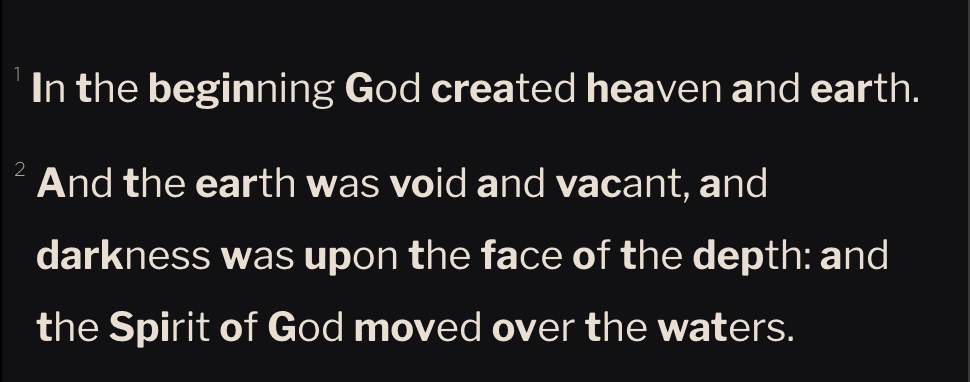
- Bionic Reading: Bolds the first syllables of each word to guide the eye across the line, reducing the cognitive effort required to track text. Particularly useful for readers with ADHD or anyone who finds sustained reading difficult. Fixation depth, saccade interval, and text opacity are independently adjustable to suit your reading pattern.
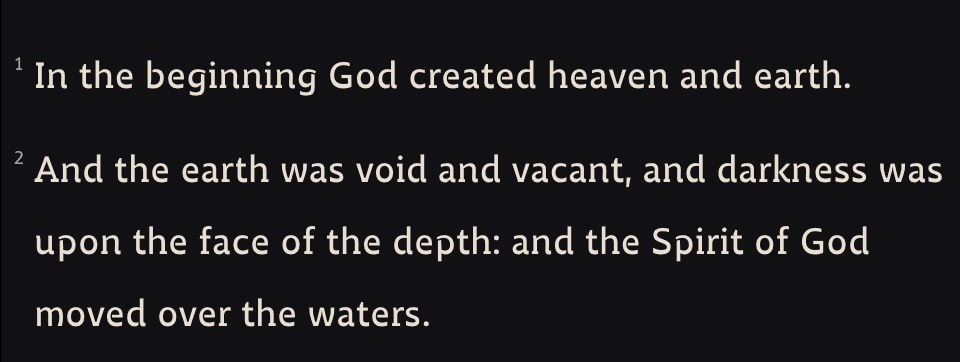
- Dyslexia font: Applies Grace Dyslexic throughout the site, not only in the reader. The typeface adds weight to the bottom of letters to anchor them to the baseline, and introduces subtle visual distinctions between letterforms that are commonly confused, such as b, d, p, and q.
Scholarly Toggles
- Book names: Toggle between the Douay-Rheims names (Isaie, Josue, Paralipomenon, Machabees) and their modern equivalents (Isaiah, Joshua, Chronicles, Maccabees).
- Psalm numbering: Switches between the Douay-Rheims numbering, which follows the Septuagint and Latin Vulgate, and the Hebrew numbering used in most Protestant and modern Catholic editions. The two traditions diverge at Psalm 9 and realign after Psalm 147.
Prayer before Reading
The praying hands icon in the top bar opens a short prayer before reading Sacred Scripture. It is the Veni Sancte Spiritus, the traditional invocation of the Holy Spirit used before the reading of Scripture and the Divine Office, presented side by side in Latin and English. The practice of praying before opening the Scriptures is as old as the Church's engagement with the Word of God, who speaks still through the text.
Mobile
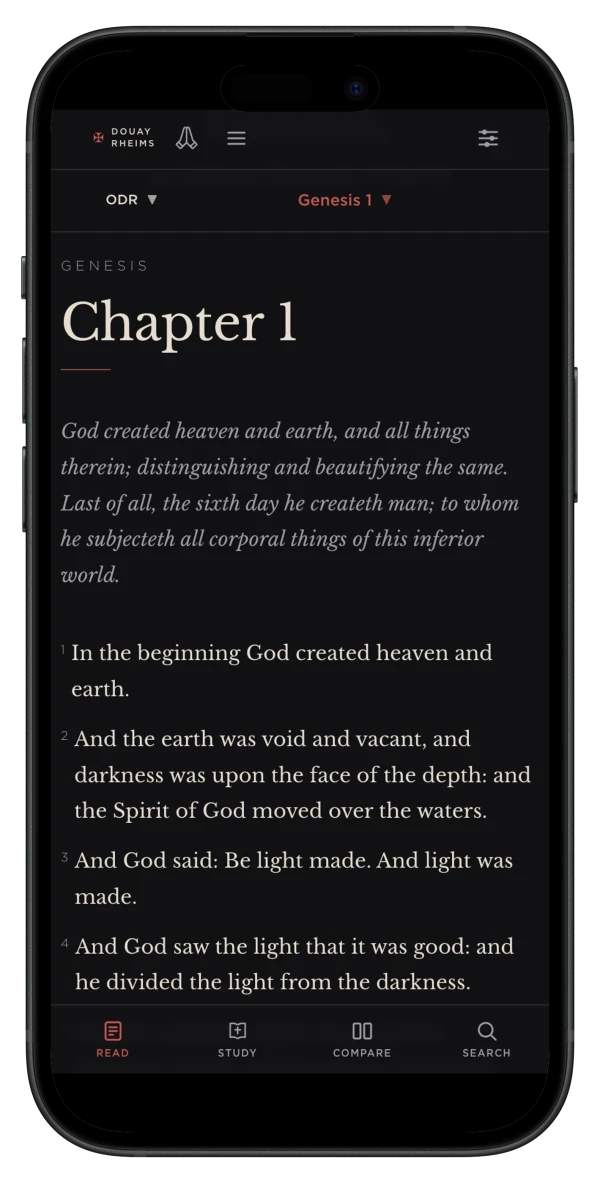
The site is fully responsive. On a phone the layout reflows around the screen: the navigation moves to a bottom bar, the text scales to the available width, and all reading options remain accessible. The site can be installed as a Progressive Web App directly from your browser, adding it to your home screen for a native app-like experience. Once installed, you can download the full text for offline reading, so the Bible is always available, even without a network connection.
Search
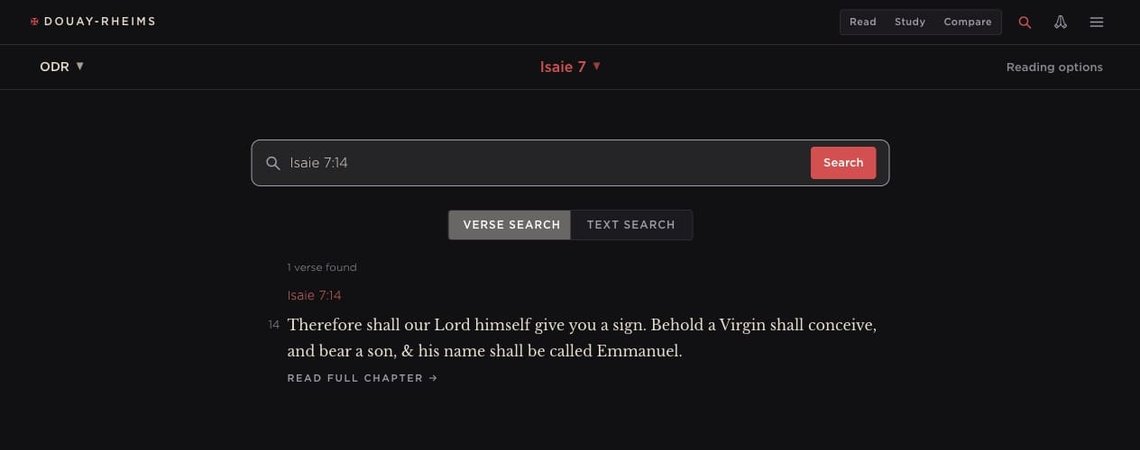
The search understands this text natively. You can type a verse reference as Catholics have always named these books: Josue, Apocalypse, 1 Machabees, Isaie. You can also type the modern equivalents; either will find your passage. Typographical ligatures are folded automatically, so searching for egypt will surface Ægypt, and caesar will find Cæsar, exactly as they appear in Gregory Martin's text.
Two scopes can be searched independently: the verse text and the notes. Searching the verses finds every occurrence of a word in Scripture. Searching the notes covers the full scholarly apparatus the translators assembled: the 1,707 annotations, all marginal notes, and the prefatory reference material from both Testaments, including the prefaces to the reader, the table of corruptions in Protestant translations, the glossary of theological terms, and all other front matter. Results from the reference material appear alongside annotations and verse notes, so a search for a doctrine or a phrase will surface not only what the translators wrote beside a verse but what they argued at length in the prefaces.
- Verse search examples: Josue 1:9, Isaie 7:14, Jn 3:16. Any reference in DR or modern naming.
- Notes search examples: holocausts, propitiation, wash me. Any word or phrase in the annotations, marginal notes, and reference documents across the full edition.
When a search term matches a word defined in the Original Douay-Rheims' own Explication of Certain Words, the glossary definition appears directly in the results, saving the step of looking it up separately.
History and Articles
History
Ten articles trace the story of the Douay-Rheims Bible from the exile that produced it to its place in American Catholic life: a story of martyrdom, dispossession, and the conviction that English Catholics deserved access to the Word of God in their own language on the Church's own terms. They begin with the founding of the English College at Douai by William Allen, follow the translators through the production of the Rheims New Testament of 1582 and the Douay Old Testament of 1609-1610, examine the theological convictions that shaped their choices, and continue through the Challoner revision of the eighteenth century to the reception of the text in nineteenth-century America. The articles are arranged to be read in sequence but each stands on its own.
Articles
Shorter pieces on specific topics: the language of the translation, its relationship to the manuscript tradition, its theological distinctives, and its influence on the King James Bible.
Reference
The original prefatory and appended material from the 1582 and 1609-1610 editions. This includes the New Testament and Old Testament prefaces, which are among the most direct statements the translators left of what they were doing and why: their argument for fidelity to the Latin Vulgate, their defence of specific translation choices, and their conviction that the Church's understanding of Christ and his mysteries must shape every rendering of Sacred Scripture. Reading the prefaces alongside the text they introduce changes how the text reads.
Also included: the translators' table of corruptions in Protestant versions, a document that reads today as a window into the confessional battles of the Reformation; the historical tables of the ages appended to the Old Testament; and the Explication of Certain Words, the glossary of theological terms that the translators included for readers unfamiliar with the Latin tradition. The Explication is the Original Douay-Rheims' own dictionary of its own vocabulary. When a word in the text is not quite what it seems, the Explication is often the surest guide to what the translators meant.
Reference material extends across four translations, each with its own apparatus:
- Original Douay-Rheims: the prefaces to both Testaments, the table of corruptions in Protestant versions, historical tables of the ages, and the Explication of Certain Words.
- Challoner Douay-Rheims: Challoner's own prefatory material, Pope Leo XIII's encyclical Providentissimus Deus on the study of Holy Scripture, prayers for reading, chronological tables of both Testaments, and the table of epistles and gospels for the liturgical year.
- Haydock Catholic Bible: the 1883 foreword, a directory of over two hundred commentators cited in the work, comprehensive introductions to every book of both Testaments, chapter summaries for the entire Bible, and a general preface on reading Scripture.
- Confraternity New Testament: background essays on the world of the New Testament, its parables, and the text's relationship to earlier Catholic translations.
All reference material is fully searchable. A search in the notes scope will surface matching passages from the prefaces and reference documents alongside verse annotations and marginal notes, with a link directly to the relevant section.